
Honey Bee Swarm Eviction Service
A honey bee swarm that has just entered your building is a very different problem to an established colony. The earlier we can assess and attend, the simpler and less expensive the job is likely to be. Leave it months and you may be looking at scaffold, structural work and a significantly larger bill. This page explains why speed matters – and what to do right now.
If you are not sure whether you have a recently arrived swarm or an established colony, see our bee nest removal page for help identifying what you are dealing with.
Swarm eviction means capturing and relocating the entire colony – including the queen – before they become fully established. The bees are removed alive and relocated to our apiary. This is not about driving them out to re-enter another cavity nearby. It is live removal carried out while the job is still straightforward: before significant comb is built, while access is simpler, and while a fixed price is still possible.
Use our swarm eviction enquiry form to get a cost indication the same day – submit photos of where the bees are entering, showing all angles including from within the property looking towards the entry point. We don’t need lots of close ups, what we usually find more useful are full height photos showing the context of the situation. If you can do this we can usually get back to you with an indication of cost on the same day.
Swarm just arrived?
Use our enquiry form to send photos and details. We can usually provide a cost indication the same day.
The earlier we can attend, the simpler and less expensive the job.
Why Acting Early Reduces Cost
When a honey bee swarm first enters a building, its at its most vulnerable and most manageable.
The colony has no established comb, no honey stores and no deep attachment to the cavity so the job can often be completed with MEWP access – significantly faster and less expensive than scaffold.
But even a recently arrived colony can become complex quickly: a productive colony in good forage can build significant comb and stores within days. Bees that enter what appears to be a simple wall cavity may expand into adjacent voids or connected spaces – something only discovered once access is made. A chimney stack with multiple flues may have bees in more than one.
Bees entering a chimney flue with a liner may require the liner to be replaced if not dealt with quickly – flexible liners often need removing to access the bees properly, and the removal process carries a high risk of damage.
We provide a cost indication once we understand your specific situation – location, access, photos, and how long the bees have been present. The variables that affect the final cost can only be fully assessed on site, which is why our default pricing is a day rate rather than a fixed price for established colony work.
MEWP vs Scaffold
A MEWP can be on site within days and costs a fraction of a scaffold erected over weeks. For commercial properties where a scaffold affects operations, car parks or pedestrian access, the cost difference is even more significant. Early action is not just cheaper – it is far less disruptive.
Pricing
Swarm eviction is the one scenario where we can offer a fixed price covering the removal and proofing work.
The job scope is predictable – recently arrived colony, no established comb, defined access – so we can provide a complete cost indication once we understand the location and access requirements.
This is one of the clearest financial arguments for acting early. A fixed all-in price is only possible while the colony is newly arrived. Once a colony has established, the job moves to a day rate basis with variables that cannot be predicted upfront – time, access method, scaffold costs – none of which can be fixed in advance.
Fixed price includes: Removal of the colony – proofing of the entry point – reinstatement of any access. Cost indication provided on receipt of enquiry information including location, photos and access details.
For a full breakdown of how our pricing works across all job types, see our pricing page.
For Facilities Managers & Estates Teams
If a honey bee swarm has entered a building on your estate, the case for early intervention is straightforward:
Early swarm eviction is a cost management decision, not just a pest control one. We provide formal cost indication documents for purchase order processes and work within your site’s induction and access requirements.
See our Commercial & Public Sector page for full details of how we work with facilities managers, estates teams and property managers – including our approach to RAMS, documentation and complex site access.
Scaffold Liaison
Where scaffold access is required we are happy to liaise directly with your scaffolding contractor on your behalf at no additional charge – advising on the precise access requirements so the scaffold is specified correctly first time. This avoids the scaffold coming back twice and ensures the bee removal can be completed on the day as planned.
For commercial clients and estates teams this is particularly useful – we can have a direct technical conversation with your scaffolder without you needing to act as go-between on a conversation about access requirements you may not be best placed to specify.
How to Tell if a Swarm Has Just Arrived
If the bees have been present for longer, or if you are seeing a steady stream of bees coming and going over weeks or months, you are dealing with an established colony rather than a newly arrived swarm. This requires a full removal – see our Honey Bees in Buildings section.
Could the Bees Be Returning to an Old Nest Site?
Yes – and this catches many property owners by surprise.
If your property has any history of honey bees – even decades ago – the scent from that old colony persists in the cavity for years, sometimes generations. Wax, propolis and queen pheromones create a powerful scent marker that passing swarms detect and investigate. To a scout bee, that cavity smells like proven real estate.
You may have no knowledge of bees ever being there. Previous owners may never have mentioned it. But if a colony occupied that space at any point in the building’s history, the scent remains – and that is why bees are entering now.
This is not reoccupation by the same colony. It is a new swarm arriving and choosing a location that has already been validated by a previous colony. From the swarm’s perspective, this is a shortcut – no need to test whether the cavity is suitable. Another colony already did that work.
What this means for you:
Even if you are certain the bees “just arrived,” the cavity itself may have a long history you are unaware of. This does not change the urgency of acting quickly – it just explains why they chose that specific entry point rather than any of the hundreds of other gaps in the building.
But it may change the job scope.
If bees are returning to a historically occupied cavity, there may be old comb, crystallised honey, propolis buildup and wax moth detritus from previous colonies still in the space. This can mean additional access is required to remove not just the new colony but the accumulated material from years or decades of occupation. What appears to be a straightforward recent arrival can reveal itself on site to be a more complex removal requiring additional time – and our pricing will need to reflect that. If the job moves beyond the scope we initially assessed, it shifts from a fixed price to a day rate basis to account for the additional work involved.
I Only Just Noticed the Bees – Does That Mean They Just Arrived?
Not necessarily. You may be seeing activity for the first time because the established colony swarmed and became noticeable.
What swarming looks like
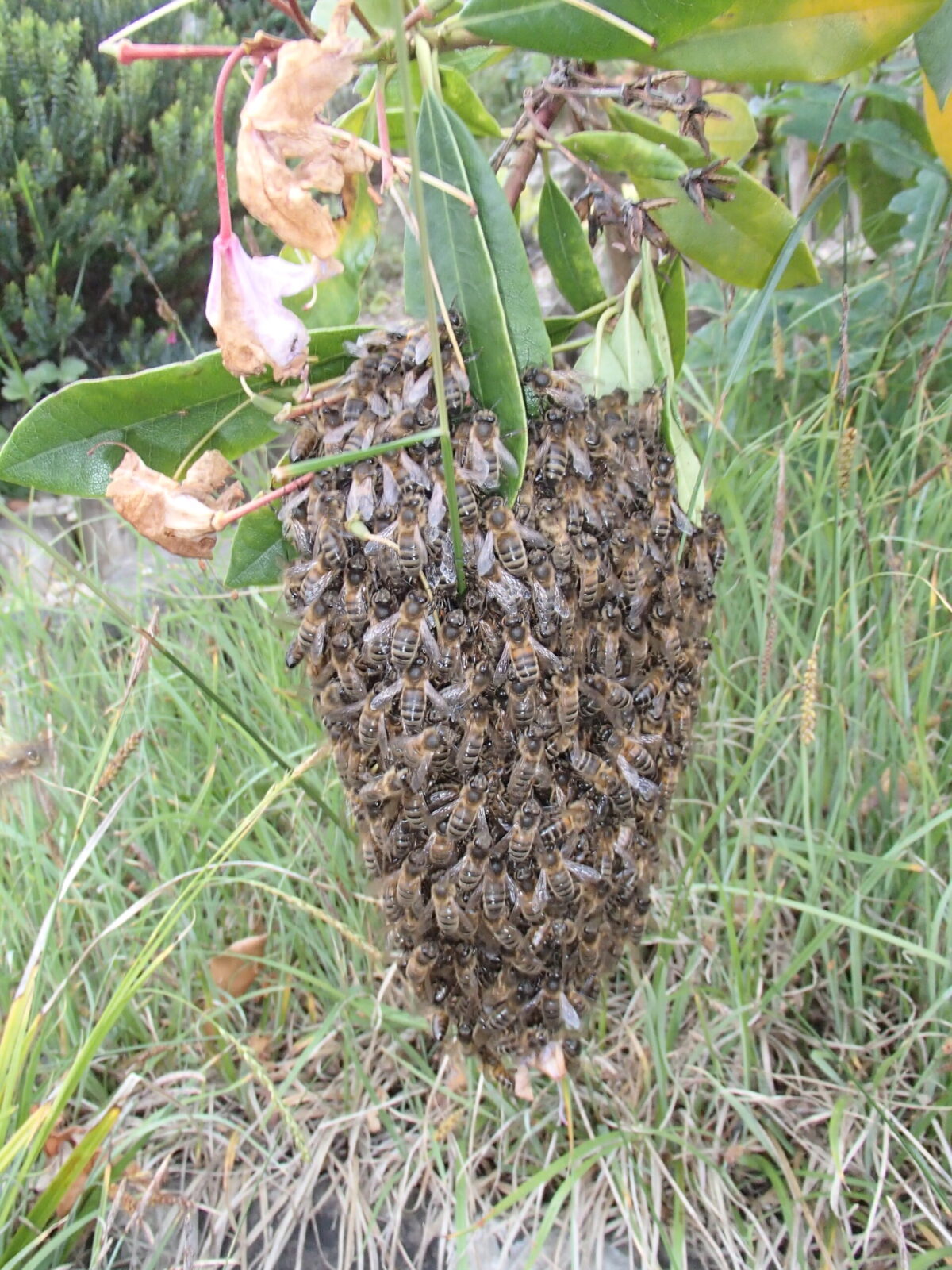
Initially a large cluster of bees appears outside the building – often hanging from a branch, roof edge, or the wall near the entry point. This can last anywhere from a few minutes to a few hours. Then the cluster moves on or re-enters the building.
If you see a swarm clustered nearby
In a tree, on a post, on the wall – look to see if you can spot any bee entrance nearby with steady activity going to and from it. If so, the swarm cluster has probably come from that location. The cluster will either leave to move onto another location, or return to where it came from.
What you may think is happening:
may be different to what is actually happening
What maybe happening:
The established colony inside the building has split. The old queen left with roughly half the workers (the swarm you saw clustering outside). The colony inside the building is still there – now with a new queen or a queen cell about to hatch. You only noticed the bees because the swarming activity was dramatic and visible. Mean while the swarm cluster has for some reason or other decided to return.
This is not uncommon.
How to tell if a NEW swarm has actually arrived
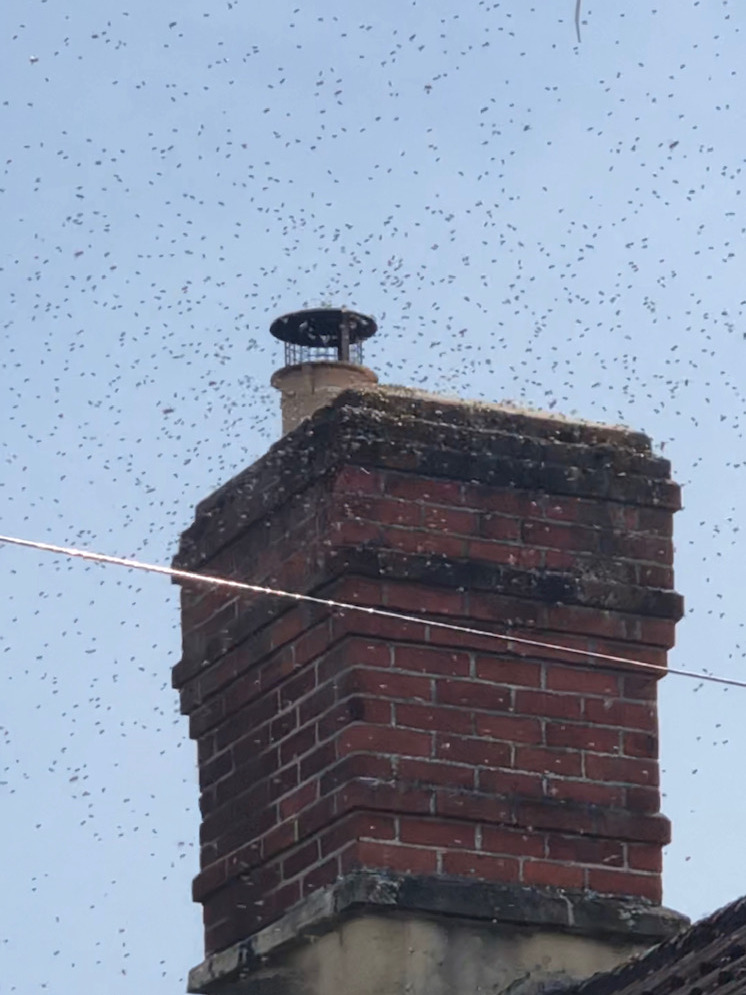
If the bees have swarmed and arrived at your property, you will see a large number of bees in the air, all flying towards a specific part of your property and moving fairly quickly into it. The activity is concentrated, directional and happens over a short period – typically minutes to an hour. There is no steady traffic beforehand because they have just found the location.
It is unlikely that you would have seen the swarm clustered nearby prior to unless they are returning to the nest they just swarmed from.
How to tell if an ESTABLISHED colony has swarmed
Look for steady traffic at the entry point before, during and after you saw the cluster.
Bees carrying yellow or orange pollen on their legs to the bee entrance.
any dark staining around the entrance.
Why this matters
If you only noticed the bees because you saw them swarming and assumed they had just arrived, they may have been established inside for months or even years. The job is not a swarm eviction – it is a full colony removal with all the implications for access, time and cost that come with that.
If you are not certain whether the bees just arrived or have been there longer, contact us with photos and we will assess the situation. The approach — and the cost – depends on getting this distinction right.
Important distinction:
Swarm eviction is not the same as a free swarm collection by a local beekeeper.
A beekeeper collecting a swarm from a branch is not the same thing. A swarm that has entered a building cavity is a completely different matter – few beekeepers have the equipment, experience or insurance to deal with it correctly. See our page on Live Removal vs Swarm Collecting for more detail.
Will They Leave on Their Own?
We are regularly told by people we attend that they were advised the bees would leave on their own accord – often by a local beekeeper, pest controller, or someone they found online.
In our experience this rarely happens once a swarm has entered a building cavity. We cannot give you reliable odds on whether they will stay or leave – our experience is clearly biased because we only attend properties where the bees have stayed. What we can tell you is this:
Once a swarm has committed to a cavity and begun building comb, they do not leave voluntarily. The investment in wax, the presence of brood, and the suitability of the space mean they are there to stay. Occasionally – in the first day or two after arrival – a swarm may move on if conditions are poor or scouts find a better location. But once settled, waiting serves no useful purpose.
Even if a colony does eventually leave or die out naturally, the scent from wax, propolis and queen pheromones remains in the cavity for years. The following season another swarm will detect it and investigate the same entry point. The problem does not resolve itself – it resets. Year on year the same spot attracts new colonies, and each successive colony that establishes makes the eventual removal more complex and more expensive.
If the bees arrived in the last day or two and you are not yet certain they have settled, watch carefully. If they are still present after 48 hours they have committed to the space and waiting will not change that.
What We Need From You – Act Fast
Speed matters. The more quickly you can get us the information we need, the sooner we can act. Please use the contact form with:
Swarm just arrived?
Use our enquiry form to send photos and details. We can usually provide a cost indication the same day.
The earlier we can attend, the simpler and less expensive the job.
Commercial sites: Also include your organisation name, your role, and any site access requirements – induction, permit to work, restricted hours. This allows us to prioritise and begin the procurement process in parallel with the technical assessment.
Should You Wait and See?
A common piece of advice is to wait and see whether the swarm moves on. In the first day or two this is not unreasonable – a swarm that has not yet fully committed to a space may occasionally move on of its own accord. But once settled, waiting serves no useful purpose.
And even if a colony does eventually leave or die out naturally, the scent from wax, propolis and queen pheromones remains in the cavity for years. The following season another swarm will detect it and investigate the same entry point. The problem does not resolve itself – it resets. Year on year the same spot attracts new colonies, and each successive colony that establishes makes the eventual removal more complex and more expensive.
The honest advice is: if the bees arrived in the last day or two and you are not yet certain they have settled, watch carefully. If they are still present after 48 hours they have committed to the space and waiting will not change that.
The honest advice is: if the bees arrived in the last day or two and you are not yet certain they have settled, watch carefully. If they are still present after 48 hours they have committed to the space and waiting will not change that. Comb building begins within 24-48 hours if conditions allow. The queen typically begins laying eggs within 2-5 days. Once eggs are laid, the colony has invested too much to leave voluntarily.
The Smoky Fire Method – Information, Not a Recommendation
There is one approach worth being aware of, though we are not recommending it and it does not solve the problem permanently.
Some people have had success encouraging a recently arrived colony to vacate a chimney by lighting a low temperature, smoky smouldering fire over an extended period – typically seven to ten days. Smoke is a natural signal to bees that their home is under threat, and a persistently uncomfortable environment can in some cases persuade a colony that has not yet fully established to move on.
Success has also been reported where bees are in an adjacent flue rather than the one being used – the smoke permeating through can have the same effect in some chimney configurations.
We are identifying this as a possibility in the right circumstances, not advising anyone to attempt it. The dangers are real and need to be understood before considering it:
- A blocked or partially blocked flue is a serious hazard – carbon monoxide risk and potential chimney fire
- A fire that runs too hot defeats the purpose and creates additional risks
- Without knowing the condition of the flue and whether it is clear, lighting any fire is potentially dangerous
- This will not work for bees in walls, roofs, soffits or any structure other than a chimney
- It is not a reliable method – success depends on the colony, the chimney configuration, timing and conditions
If you do not know the condition of your flue, do not attempt this. Have the chimney swept and inspected first. And if it works – if the bees do move on – the proofing requirement remains exactly the same. The scent is still in the cavity, the entry point still needs addressing, and the same spot will attract another swarm the following season if nothing is done.
For full detail on the risks and conditions required, see our page on smoking bees out.
This method does not capture the queen. The colony is driven out but not removed.
They will likely re-enter another cavity nearby – often in a more difficult location. The scent remains in the original cavity and will attract another swarm the following season. The problem is transferred, not solved. We include this information because people ask about it and will find it elsewhere online – not because it is a responsible solution.
When Eviction Is No Longer an Option
If a colony has been established for more than a few weeks, or if significant bee activity has been present over one or more seasons, swarm eviction is no longer appropriate. The colony will need to be removed using cutout, trap-out or exclusion methods depending on the structure.
This is not a reason to delay calling us – we will assess your situation and advise on the most appropriate approach. We carry out full colony removals from all types of structures nationwide.

If Bees Are Getting Into Your Building
Immediate action while waiting for removal:
Bees entering through the fireplace:
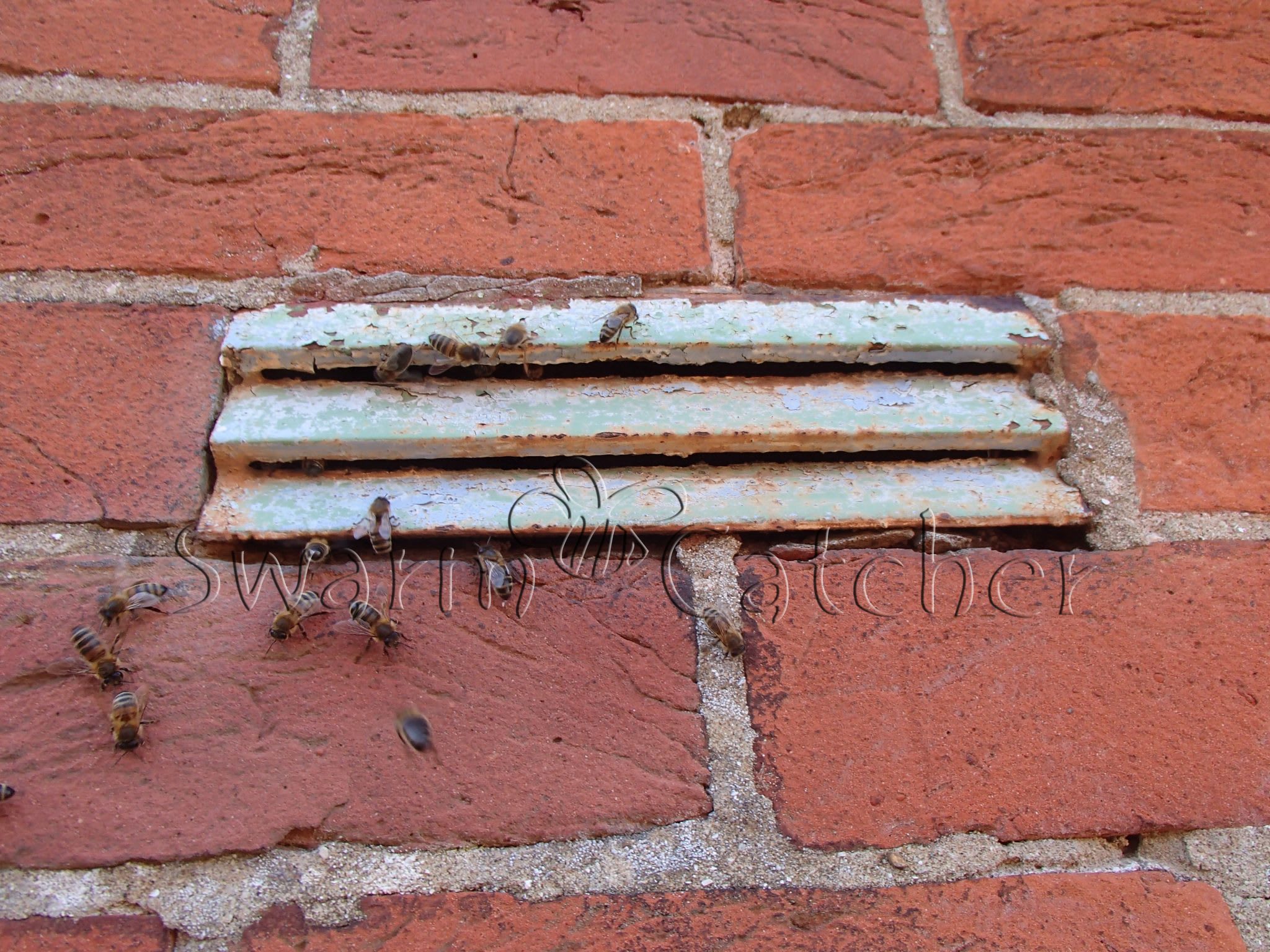
Bees entering through air vents or airbricks:
Bees entering through light fittings (flat roofs, dormers, ceiling voids):
Commercial sites – same concepts as above:
Do not light a fire:
If bees are present in a chimney the bees may be reoccupying an old nest – melting wax and honey is a fire hazard – a fire is likely to cause the bees to drop to bottom of the flue en masse.
See our page on Smoking Bees Out for full detail on the risks.
FAQ’s
New swarms arrive suddenly in large numbers with no previous bee activity at that location. Established colonies have been present for weeks or months with a steady stream of bees. If you see bees returning with yellow pollen on their legs, they’ve started raising brood and are establishing.
Yes. The scent from a colony removed years ago – even decades ago – persists in the cavity and attracts new swarms. If your property has any history of bees, assume the scent is still there. This is why they chose that specific entry point.
Act immediately – but be aware that if bees are returning to a historically occupied site, there may be old comb and material from previous colonies still in the cavity. This can affect the job scope and move it from a fixed price to a day rate basis if additional work is required on site.
Not necessarily. You may have noticed them when the established colony swarmed – a large cluster appeared outside before re-entering. If you now see steady traffic in and out, or bees carrying pollen, they were probably already there. Contact us with photos and we’ll assess whether it’s a new swarm or an established colony.
We prioritise swarm evictions due to the time-sensitive nature. Use our enquiry form with photos and location – we can usually provide a cost indication the same day.
A recently arrived swarm can often be removed with MEWP access at a fixed price. Once established, store volume increases, colonies expand into adjacent voids, chimney liners become compromised, and scaffold becomes necessary at height
Rarely. Once a swarm has committed to a cavity and begun building comb, they do not leave voluntarily. Even if they did, the scent remains for years and attracts another swarm the following season.
A beekeeper can collect a swarm from a branch. Once bees have entered a building cavity, few beekeepers have the equipment, experience or insurance to deal with it correctly
In most cases yes – fixed price for swarm eviction includes removal of the colony, proofing of the entry point, and reinstatement of any access.
No. We capture and relocate the entire colony – including the queen – alive to our apiary. This is live removal, not extermination.
Yes. See our Commercial & Public Sector page for how we handle permits, inductions, site-specific RAMS and procurement documentation.
Yes. The entire colony – queen, workers and brood – is relocated alive to our apiary and continues as a working hive.
The bees remain active pollinators. We do not use pesticides or extermination methods.
This is genuine live removal and relocation.
If we suspect the colony is diseased we will exterminate it rather risk spreading disease to other colonies.
Learn more About Us – 20+ years specialist experience.
Our honey bee relocation Specialist is waiting for you!
Swarmcatcher are the UK honey bee colony removal specialists that provide an ethical eco-friendly bee removal and relocation service across the UK.
Honey Bees in Roof
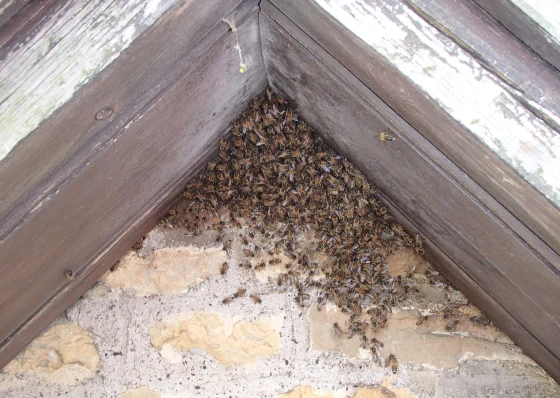
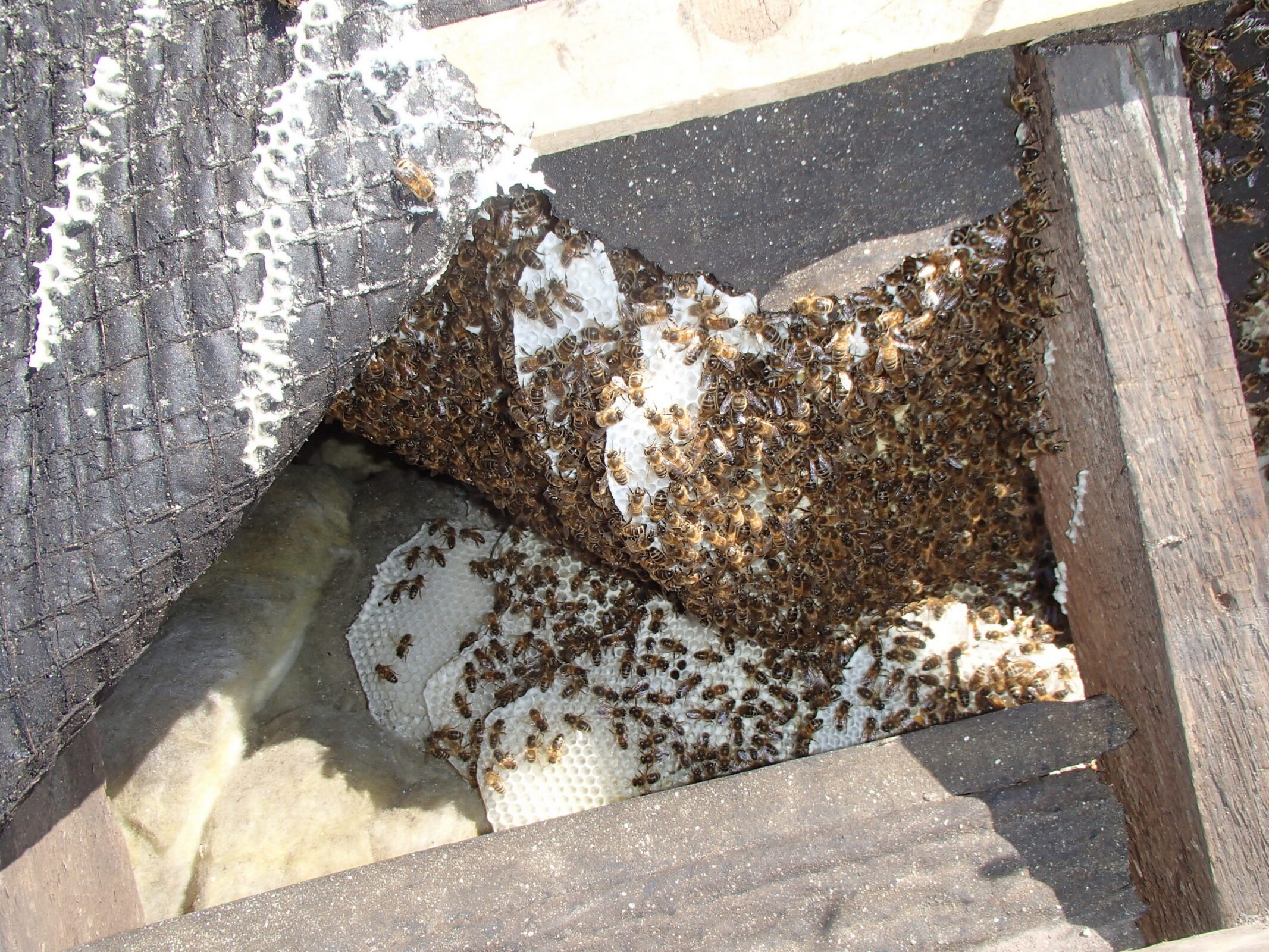
Generally speaking honey bees don’t colonise large roof spaces, when they are flying in beneath tiles they more often than not are colonising a cavity wall or an old dismantled chimney stack that is hidden beneath the tiles. But they love dormer windows and flat roofs

Honey Bees in Chimney
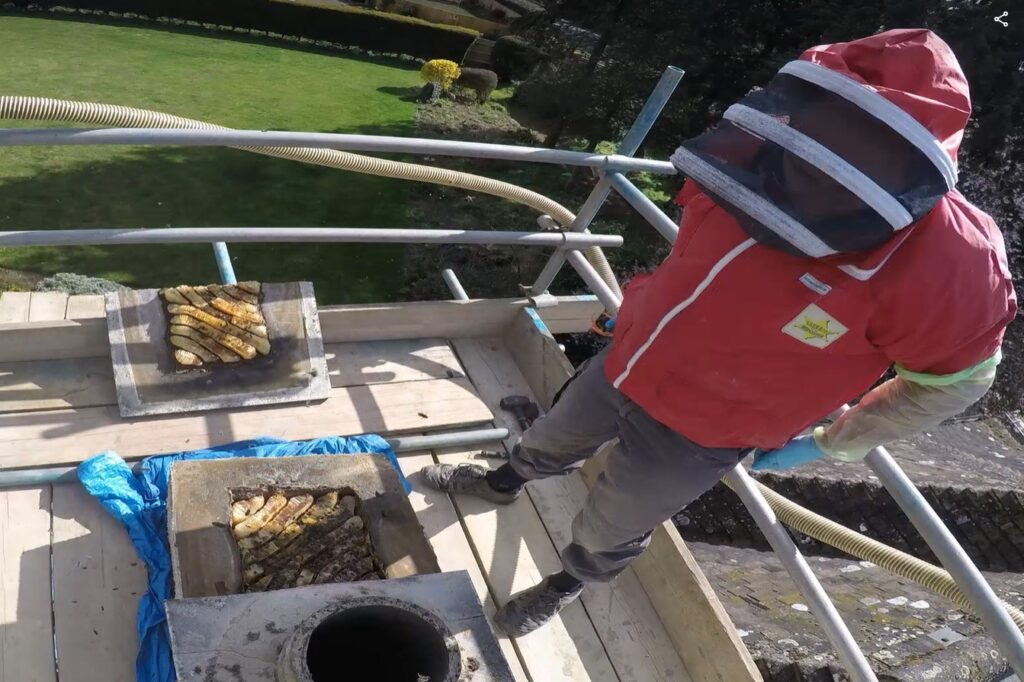
We attend more chimney honey bee removals than we do of any other type of honey bee removal or cutout. We don’t need to dismantle the chimney, we rarely remove more than 4 individual bricks. When honey bees occupy a chimney space it is usually one of three scenarios or a combination of them.
Honey Bees in Wall
We remove bees from walls and we can do it without taking them down or knocking huge holes into them. We remove the bees the wax & the honey. Rarely do we need to remove more than 8 bricks, which we remove whole so they go back as they were.
For further information on bee removal and relocation please use the contact form in the side bar or message button below.
If you are looking for information on removing bees from a chimney check out our article Honey bees in chimney, or if you repeatedly have bee swarms take up home in your chimney you may want to look at our page Why honey bees like chimneys & Everything you need to consider when removing bees in a chimney which is a fairly extensive overview.
For information on bee removal and relocation from roofs you may want to look at our page Honey bees in roof, or if you have honey bees in a wall our page Honey bees in wall maybe of use.
For examples on removals of honey bees from these and other more unusual places check thru The Hive Blog and investigate our Tag cloud too.
Don’t forget a general overview on honey bee removals which can be found at Live honey bee removal.
