
Honey Bee Removal for Commercial & Public Sector Organisations
Specialist commercial honey bee removal across England, Scotland and Wales.
When a honey bee colony takes up residence in a commercial building, public sector site or heritage property, the stakes are higher than a domestic infestation. You have health and safety obligations, a duty of care to staff, visitors and the public, and in many cases a procurement process to navigate before you can appoint a contractor.
SwarmCatcher has been removing honey bee colonies from commercial, public sector and heritage buildings for over 20 years. We understand how organisations work – and we make the process as straightforward as possible, starting with understanding your situation rather than drowning you in paperwork.
Health & safety:
Honey bees pose a serious risk to anyone passing near a colony entrance. Under health and safety law, organisations have a clear responsibility to address this for employees, visitors and the public alike. The longer a colony is established, the greater the risk – colonies can become more defensive over time, often this is particularly noticeable after a change in the Queen such as after a swarming event.
For recently arrived swarms where early intervention can significantly reduce costs, see our Urgent Swarm Eviction page.
Sectors We Work In
Local Councils & Public Sector
Housing stock, civic buildings, public spaces
Schools, Colleges & Universities
Safeguarding requirements, term-time scheduling, minimal disruption to teaching environments
Heritage & Listed Buildings
Specialist low-impact methods, understanding of controlled structures and conservation requirements
Churches & Religious Buildings
Sensitive working with historic fabric, understanding of listed structure constraints
Commercial Offices & Retail
Minimal disruption to operations, fixed-price options, formal cost indication for PO processing
Healthcare & Medical Facilities
Hospitals, care homes, GP surgeries and clinics – familiar with working around vulnerable patients, clinical schedules and site-specific access requirements
Military Sites
Familiar with site access protocols, induction requirements and security considerations
Energy & Power Infrastructure
Experienced working in and around high voltage substation environments — familiar with exclusion zones, access protocols and the specific H&S requirements of power providers
Chemical Industry & Process Plants
Experience at chemical industry sites with permit-to-work systems, site induction, PPE standards and COSHH-adjacent considerations
Heavy Industry & Manufacturing
Large industrial facilities with complex access, continuous-process operations and minimal disruption requirements
We understand colony behaviour – see our Honey Bees in Buildings page for detail on why delay makes the problem worse.
Why Commercial Clients Choose SwarmCatcher
We Understand the Job Before Producing Documentation
Many contractors issue generic RAMS and method statements before they have set foot on site or understood the specific risks involved. We take a different approach.
Our priority is to fully understand your situation first – the building type, the location of the colony, access requirements and any site-specific risks. Only once we understand the job do we produce site-specific RAMS and method statements tailored to your property. This means the documentation your health and safety team receives is accurate, relevant and actually written for your site.
Once appointed:
We supply everything your procurement team needs – site-specific RAMS, method statement, public liability insurance certificate, company registration details, health and safety policy and references from similar organisations.
Fully Insured for All Property Types
We carry full public liability insurance for all types of property — heritage, listed, commercial, industrial and public sector buildings. Insurance documentation is provided on appointment.
IPAF & PASMA Certified – Working at Height
Our team holds IPAF and PASMA certification for working at height, which is a requirement for many commercial and industrial bee removal jobs involving rooflines, high chimney stacks and elevated access. We bring our own equipment and have the certification to satisfy your permit-to-work requirements.
Specialist Heritage & Listed Building Experience
We regularly work for major heritage organisations and on Grade I and Grade II* listed properties. We understand that chimneys are controlled devices, that lime mortar behaves fundamentally differently from modern cement, and that the wrong approach can cause structural damage far more costly than the removal itself.
Our minimal-impact methodology – rarely removing more than four bricks for a chimney job – is especially important where conservation officers or planning requirements are involved. We have the tools, knowledge and experience to work correctly on sensitive structures.
Experience in Working Near High Voltage Infrastructure
We have carried out honey bee removals at electrical substations and in proximity to high voltage infrastructure for power providers. This work demands a thorough understanding of exclusion zones, safe working distances and the specific access and induction protocols that energy companies require before any contractor can enter site.
Honey bee colonies are naturally drawn to the enclosed cavities and warmth of substation buildings and associated structures. We understand both the bee behaviour and the site constraints – and we write RAMS that reflect the actual risks present at that specific location, not a generic template.
Experience in Complex Industrial Environments
We have worked in demanding industrial environments including chemical industry sites, heavy manufacturing and process industries. These sites have specific contractor requirements that go well beyond standard pest control – permit-to-work systems, site-specific induction, PPE standards, process area exclusion zones and H&S protocols that must be followed precisely.
A honey bee colony near a process area, ventilation intake or employee thoroughfare on an industrial site is not a nuisance — it is a health and safety matter. We understand both the bee behaviour and the site constraints, and our RAMS reflect the actual risks present at your specific location.
Nationwide Coverage with Site Access Experience
We operate across England, Scotland and Wales. We are accustomed to the requirements of managed sites – induction processes, permit-to-work systems, restricted working hours and security protocols. Tell us what your site requires and we will accommodate it.
Pricing – Day Rate Basis
We price on a day rate basis. Once we understand your situation through the enquiry process — location, property type, access requirements, number of operatives needed and photos – we provide a full written cost indication showing whether the job is likely to require one day or two, and the total cost. There are no hidden extras.
Access costs such as MEWP or scaffold hire are quoted separately where required. We provide formal cost indication documents compatible with purchase order and procurement requirements.
Scaffold Liaison – At No Additional Charge
Where scaffold access is required we are happy to liaise directly with your scaffolding contractor on your behalf at no additional charge. We advise on the precise access requirements for the removal so the scaffold is specified correctly first time – avoiding the cost and disruption of the scaffold returning for a second visit because the brief was wrong.
For facilities managers and estates teams managing complex or listed structures, this removes the need to act as go-between on a technical conversation about access requirements you may not be best placed to specify. We deal with the scaffolder directly.
NACE & BPCA Members
SwarmCatcher are associate members of the National Association of Chimney Engineers (NACE) and full members of the British Pest Control Association (BPCA), demonstrating adherence to codes of practice in both chimney engineering and pest management.
How It Works
Our process is designed to get to resolution quickly without unnecessary site visits or upfront paperwork.
1. Initial enquiry
Use the commercial contact form below. Tell us your organisation, your role, the site location and a brief description of the situation. Photos help but are not essential at this stage.
2. We assess your situation
We contact you to gather further detail using our structured information-gathering process. In most cases this removes the need for a pre-removal site survey, saving time and cost. If a site investigation is needed we will tell you and explain why. More on our site investigation process at our Honey Bee Surveys page.
3. Cost Indication
We provide a cost indication on a fixed price or day rate basis, with a formal cost indication document for your records and purchase order process.
4. Documentation package
On appointment we supply site-specific RAMS, method statement, insurance certificate, company registration details, health and safety policy and references — everything your procurement and H&S teams require.
5. Removal and reinstatement
We carry out the removal, relocate the colony, remove all wax, honey and detritus, and reinstate and proof the entry point. We leave the site clean, tidy and bee-free.
If Bees Are Getting Into Your Building
Immediate action while waiting for removal:
Bees entering through the fireplace:
Do not light a fire:
If bees are present in a chimney the bees may be reoccupying an old nest – melting wax and honey is a fire hazard – a fire is likely to cause the bees to drop to bottom of the flue en masse.
See our page on Smoking Bees Out for full detail on the risks.
Bees entering through air vents or airbricks:
Bees entering through light fittings (flat roofs, dormers, ceiling voids):
Commercial sites – multiple entry points:
At a Glance
| Credential | Detail |
|---|---|
| Membership | NACE – National Association of Chimney Engineers BPCA – British Pest Control Association, full member |
| Working at Height | IPAF & PASMA certified |
| Insurance | Full public liability — all property types including heritage and listed buildings |
| RAMS | Site-specific risk assessments and method statements for every commercial job |
| Experience | 20+ years specialist honey bee removal |
| Heritage | Regular work for major heritage organisations — listed and Grade I properties |
| Healthcare Facilities | Experience working in hospitals, care homes and medical facilities – familiar with working around vulnerable patients, clinical schedules and site-specific access requirements |
| Military | Experience working on military sites with associated access requirements |
| High Voltage Environments | Experienced working in and around electrical substations — familiar with exclusion zones, access protocols and H&S requirements |
| Industrial Environments | Experience at chemical industry sites and heavy manufacturing — familiar with permit-to-work systems, site induction and complex H&S protocols |
| Education | Schools, colleges and universities – understanding of safeguarding requirements and term-time scheduling |
| Coverage | Nationwide — England, Scotland and Wales |
| Scaffold Liaison | Happy to liaise with your scaffolding contractor at no charge — advising on access requirements so the scaffold is specified correctly first time |
| References | Available on request from councils, heritage organisations and commercial clients |
We regularly work on Honey Bees in Chimney removals – the most common commercial scenario followed closely by Honey Bees in Walls.
How We Price
We price once we understand the job – location, property type, access requirements and the scenario you have described. Our cost indication process is designed to give you an accurate figure without requiring a site visit in most cases.
We price on a day rate basis, indicating clearly whether the job is likely to be completed in one day or whether a second day will be required and what that costs. Where access equipment such as a MEWP or scaffold is needed, this is quoted separately. There are no hidden extras.
Where scaffold access is required we are happy to liaise with your scaffolding contractor directly at no charge, ensuring the access is specified correctly before anything is erected.
Fixed price is available for straightforward jobs. For more complex work a day rate with a clear indication of likely duration gives you a more accurate picture than a fixed price that has to build in excessive contingency.
For residential clients, our pricing page explains the full cost breakdown including day rates, access costs and what’s included.
To receive a cost indication:
Complete the commercial enquiry form below. The more information you can provide – including photos – the more accurate our cost indication will be and the faster we can turn it around.
NB Quality photographs of the elevation and internal location allow us to assess access requirements (MEWPs/Scaffolding) remotely, reducing the need for a site survey.
Credentials
BPCA Full Members
British Pest Control Association accredited, adhering to strict professional codes of practice.
Fully Insured
Full Public Liability Insurance specifically covering high-risk environments, heritage, and Grade I listed buildings.
Compliance & Safety
Site-Specific RAMS
We provide tailored Risk Assessments and Method Statements for every individual project.
Access Expertise
IPAF & PASMA Certified
Qualified for high-level access including MEWPs, chimney stacks, and industrial rooflines.
Scaffold Liaison
We deal with your scaffolder directly at no extra charge to ensure the brief is right the first time.
20+ Years Experience
Proven track record with Military, Energy, and Heritage sectors nationwide across the UK.
FAQ’s
Yes – site-specific Risk Assessments and Method Statements are written for your property once we understand the job.
We don’t produce generic templates.
Yes – full public liability insurance for all property types, including Grade I and II*.
Yes – fully compliant with PTW, site induction, and H&S access requirements.
Yes – formal cost indication documents provided for PO and procurement processing.
Yes, on request.
In most cases no – we gather sufficient information remotely.
We will advise if a survey is needed.
Depends on location and urgency – contact us to discuss. We cover the whole of England, Scotland and Wales.
Yes. We work at height from MEWPs and scaffolding as standard, and where rope access is the only practical route, one of our team is an arborist and can reach the work on ropes.
Yes – we are specialists in live removal and relocation. Colonies are relocated to our apiary and rehomed, not destroyed.
This is both ecologically responsible and often a requirement for public sector and heritage sites.
Yes – proofing is included as part of every removal.
Our approach focuses on structural integrity and long-term prevention.
We seal entry points, address vulnerable areas, and ensure the work is done correctly so bees don’t return in the following seasons.
Our approach to Proofing & Guarantees is designed for long-term prevention.
Learn more About Us – 20+ years specialist experience.
Our honey bee relocation Specialist is waiting for you!
Swarmcatcher are the UK honey bee colony removal specialists that provide an ethical eco-friendly bee removal and relocation service across the UK.

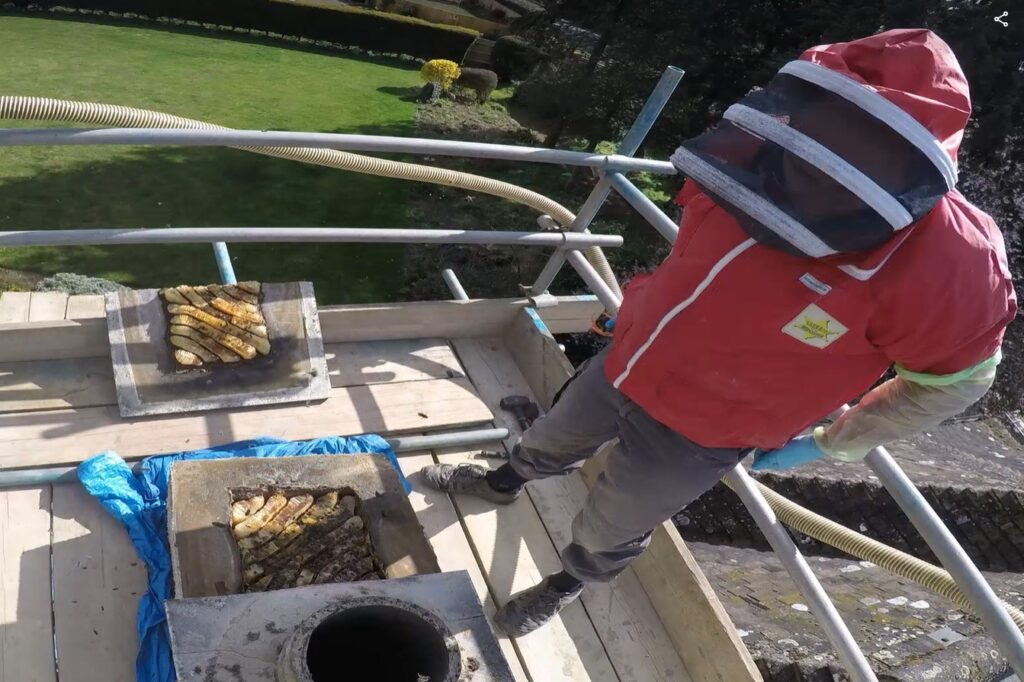
Honey Bees in Chimney
We attend more chimney honey bee removals than we do of any other type of honey bee removal or cutout. We don’t need to dismantle the chimney, we rarely remove more than 4 individual bricks. When honey bees occupy a chimney space it is usually one of three scenarios or a combination of them.
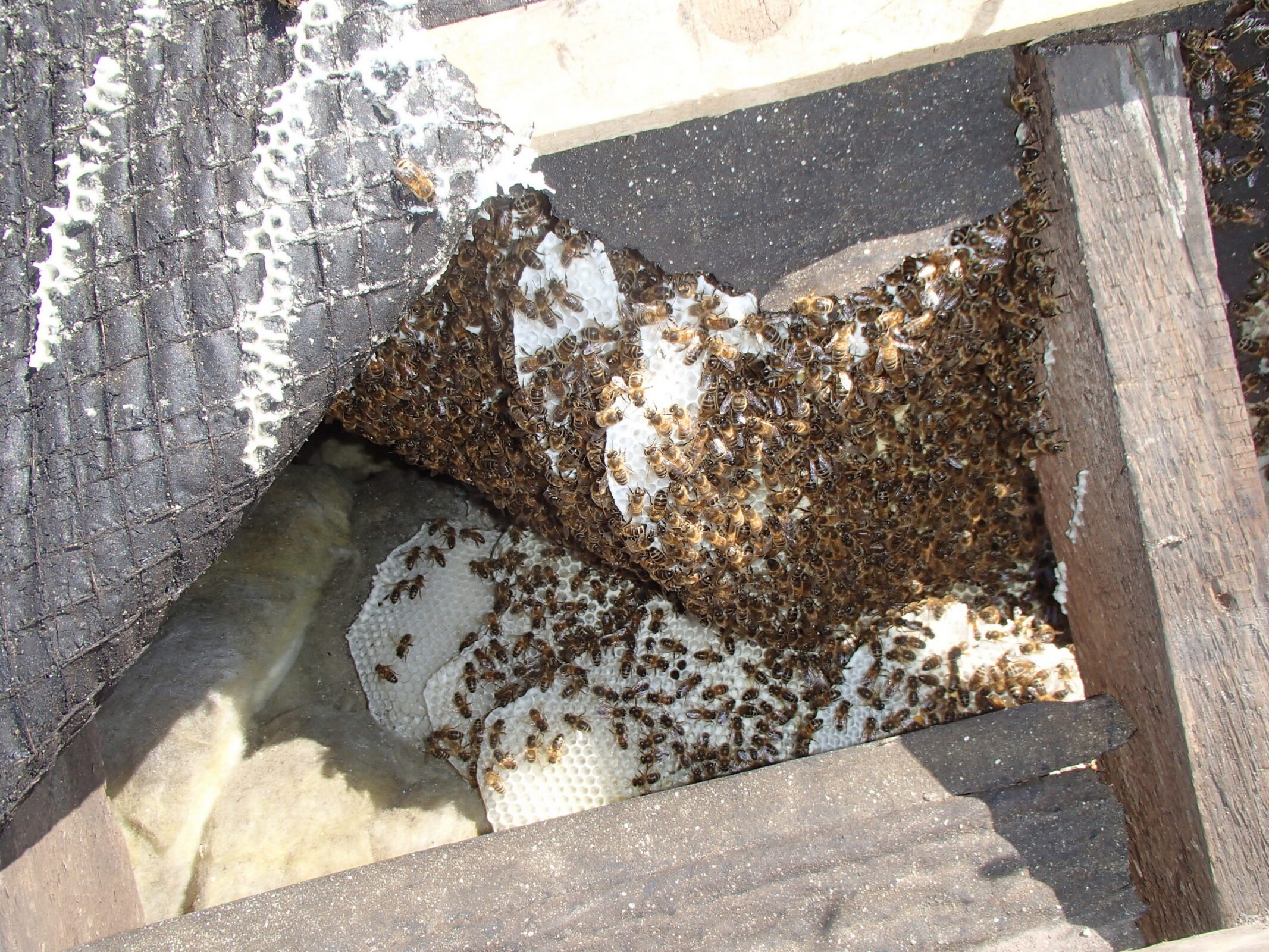
Honey Bees in Roof
Generally speaking honey bees don’t colonise large roof spaces, when they are flying in beneath tiles they more often than not are colonising a cavity wall or an old dismantled chimney stack that is hidden beneath the tiles. But they love dormer windows and flat roofs
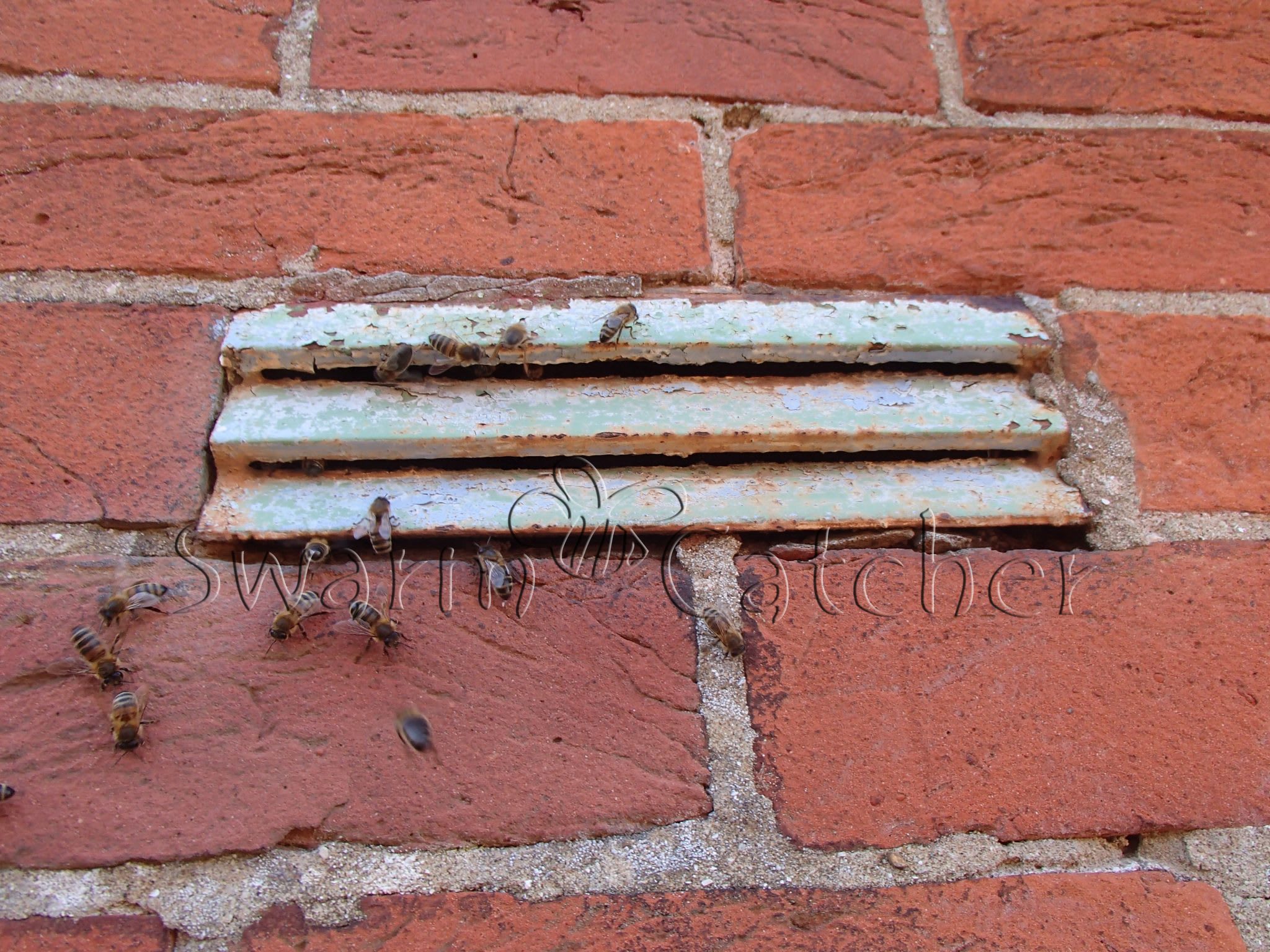
Honey Bees in Wall
We remove bees from walls and we can do it without taking them down or knocking huge holes into them. We remove the bees the wax & the honey. Rarely do we need to remove more than 8 bricks, which we remove whole so they go back as they were.
For further information on bee removal and relocation please use the contact form in the side bar or message button below.
If you are looking for information on removing bees from a chimney check out our article Honey bees in chimney, or if you repeatedly have bee swarms take up home in your chimney you may want to look at our page Why honey bees like chimneys & Everything you need to consider when removing bees in a chimney which is a fairly extensive overview.
For information on bee removal and relocation from roofs you may want to look at our page Honey bees in roof, or if you have honey bees in a wall our page Honey bees in wall maybe of use.
For examples on removals of honey bees from these and other more unusual places check thru The Hive Blog and investigate our Tag cloud too.
Don’t forget a general overview on honey bee removals which can be found at Live honey bee removal.
