
Honey Bee Removal Cost & Pricing
Specialist Live Bee Removal for facilities managers, estates teams, property managers and heritage organisations – Nationwide
Honey bee removal cost depends on several factors – the type of job, how long the colony has been established, where you are in the UK and what access is required. This page explains how we price our work honestly, so you know what to expect before you enquire.
We do not publish fixed price lists because most honey bee removal jobs are genuinely different from one another. A recently arrived swarm in a terraced house chimney is a very different job to a three-year-old established colony in the cavity wall of a listed farmhouse. Quoting the same price for both would be wrong for one of you.
What we do instead is provide a written cost indication once we understand your specific situation – and we do that remotely in most cases, without needing to visit site first.
No hidden extras:
Our cost indications cover the removal, reinstatement and proofing work we agree to carry out. Access costs such as MEWP or scaffold hire are quoted separately where required and always discussed upfront. Materials and consumables – proofing mesh, mortar, adhesive floor protection or specialist products we may use – are charged at cost when needed and always discussed on the day
Two Pricing Models
Depending on the type of job, we price on one of two bases:
Fixed Price
Available for swarm eviction jobs. Recently arrived colony – no established comb.
Covers removal and proofing.
Cost indicated once we understand location and access.
Most predictable scenario – best for early action.
Day Rate
Established colony removals.
First 8 hours – full day rate. Additional hours charged hourly.
Second day if required – minimum 4 hours plus hourly rate thereafter.
Cost indication shows 1 or 2 days expected.
The most important thing to know about pricing:
Acting early when a swarm first arrives is significantly less expensive than dealing with an established colony. A recently arrived swarm can often be evicted at a fixed all-in price. The same job six months later – with established comb, possible scaffold access and a more complex removal – can significantly add to the costs.
See our Urgent Swarm Eviction page for the full cost comparison.
What Affects the Cost
The following factors all influence the final price – which is why we ask for information and photos before quoting rather than giving a figure over the phone:
Factor | Lower Cost | Higher Cost |
How long bees have been present | Recently arrived – days. Fixed price possible. | Established – months or years. Day rate applies. |
Location in the building | Accessible chimney or wall entry point | Concealed void, restricted or complex structure |
Access required | Ground level or low roof – ladder access | High level – scaffold required for established colonies |
Volume of honey | Little or none – recently arrived colony | Significant stores – established colony, liquid in summer |
Strength and state of comb | Firm and manageable | Soft summer wax, brittle winter wax, fragile new comb |
Complexity of structure | Straightforward access and configuration | Shared stacks, awkward flues, unexpected voids |
Number of operatives | One person sufficient | Two required for safe working |
Reinstatement required | Simple brick replacement or repointing | More involved reinstatement on completion |
Time of year | Autumn and winter – off-peak | May to July – peak season, higher demand |
Location in the UK | Can be combined with nearby jobs in the area | Standalone journey travel costs apply |
Colony productivity & forage | Poor forage, slow building | Good forage – significant comb and stores within days |
For more on what to expect with an established colony, see our Honey Bees in Buildings page
Chimney liners:
Bees entering a chimney flue with a liner often occupy the space between the liner and the chimney wall. Accessing the bees properly may require liner removal.
Flexible flue liners become brittle over time and the removal process carries a high risk of damage even when carried out carefully. We cannot guarantee a liner will survive removal intact.
We will not remove a flue liner unless the client accepts it is being replaced. Early action – before significant comb is built and extends into the liner void – may avoid the need for liner removal entirely. Once bees have established in this space, liner replacement is often unavoidable.
Access Costs
Access costs are quoted separately from the removal price and are always discussed before work commences.
They are not included in the day rate or fixed price.
MEWP – Mobile Elevating Work Platform
A MEWP (cherry picker) is primarily useful for recently arrived swarms where the work is at or near the entry point rather than deep inside a structure.
For swarm eviction a MEWP can often be on site within days – significantly faster and less expensive than scaffold, and one of the key reasons early action is less expensive.
For established colony removals, where the work requires sustained access inside a cavity or chimney a MEWP is rarely the most practical method. Scaffold is generally required for these jobs at height – it provides the stable working platform needed to complete the removal properly.
Scaffold
Scaffold is the standard access method for established colony removals at height. It provides the stable working platform needed to get into and work inside a chimney, wall cavity or roof structure over the time required to complete the job properly.
Scaffold costs more than a MEWP and takes longer to arrange – typically several days lead time versus a MEWP which can often be deployed within days. This is one of the reasons established colony removals cost more than swarm evictions, and why acting early while MEWP access is still appropriate saves money.
The configuration and condition of scaffold affects how much working time is actually available for the removal. Scaffold that is incorrectly positioned, poorly erected or requires repositioning during the job can add significantly to time on site – in some cases pushing a one-day job into a second day.
This is one of the most practical reasons to involve us in the scaffold brief before it is erected. We are happy to liaise directly with your scaffolding contractor at no additional charge to ensure the scaffold is specified correctly for the removal first time.
If you would prefer us to arrange scaffold directly and provide a single turn-key price, we can do that – though the scaffold cost in that arrangement includes our markup for managing the coordination. For most clients, arranging scaffold yourself with our free liaison support is more economical.
Two Operatives
Some jobs – particularly those at height, on commercial sites or in complex structures – require two operatives for safe working. Where this is the case we will say so in the cost indication.
A two-person day costs more than a single operative day but is sometimes the only way to do the job safely and correctly.
How We Assess and Price – No Site Visit Usually Required
Most bee removal contractors charge for a site survey before they can give you a price.
We rarely need to visit site before quoting.
Our structured enquiry process – photos, location details, a few specific questions – gives us enough information to assess the job and provide an accurate cost indication in the majority of cases.
This saves you time and cost. It also means we can often turn a cost indication quickly, which matters when a recently arrived swarm needs acting on fast.
Most assessments are done from your photos and description at no charge. Where a site survey is needed, its cost depends on distance, urgency and whether an overnight stay is involved, and a good percentage of it is normally offset against the work.
Why We Don’t Quote Over the Phone
We are often asked for a price over the phone.
We understand why – you want to know what its going to cost.
But quoting over the phone is how errors are made.
Without photos, without understanding the structure, without knowing the full situation, we would be guessing.
That guess is either too low – and we adjust it up later when we discover the true extent of the work – or too high to cover every possible variable, and you pay for contingencies that don’t apply to your job.
Neither is honest or fair to both parties
What we need to provide an accurate cost indication appears in the next section. Once we have that information we can assess the job properly and give you a realistic figure – not a phone guess that creates problems later.
This is why we ask for photos and details via the contact form. The information we need to quote accurately is the same whether you phone or email – having it upfront means we can respond with a proper cost indication, not an estimate that falls apart later.
What We Need to Price the Work
- Any known access constraints
- Clear photos of where the bees are entering the building
- A photo showing the full height of the property
- Full address – we look at the property on Google Maps as part of our assessment
- How long the bees have been present
- Property type – residential, commercial, listed building etc
Commercial clients:
We provide formal cost indication documents compatible with purchase order requirements. We can provide a fixed price once all variables are understood and covered depending on what suits your procurement process. See our Commercial & Public Sector page for full details.
What’s Included in the Price
Unless otherwise stated in the cost indication, our price covers:
- Removal of the honey bee colony
- Removal of all wax comb, honey and bee detritus
- Relocation of the colony to our apiary
- Reinstatement of any access – bricks, pots, pointing where within our scope
- Proofing of the entry point against reinfestation
- Practical advice on anything beyond our scope that may need a local specialist
What’s Not Included
Access costs – MEWP or scaffold hire, quoted separately
Significant lime mortar or specialist building work beyond straightforward repointing – a local specialist experienced in the material will complete the work faster (it’s second nature to them, not a secondary skill), can access necessary materials more easily at lower cost, and can be flexible about return visits to check that mortar and pointing has set correctly allowing for variances in weather. We weatherproof the structure sufficiently on the day so the specialist can attend when conditions are right for their work.
Roof repairs beyond straightforward tile or slate replacement at the access point – bees often extend pre-existing roof damage that allowed them access in the first place, and a local roofing specialist will complete the work faster (it’s second nature to them, not a secondary skill), can access necessary materials more easily at lower cost, and can be flexible about return visits to check that cement and pointing has set correctly allowing for variances in weather. We weatherproof the structure sufficiently on the day so the roofer can attend when conditions are right for their work.
Redecorating or internal making good beyond the immediate access area
On building work:
We are specialists in bee removal, not building contractors. We carry out the straightforward reinstatement that forms part of every removal. For anything requiring skilled lime mortar work or significant structural repair, we advise you honestly and recommend using a local specialist – we are not local to most of our jobs, our day rate is usually higher than a local builder’s rate, and that work is better done by someone who is local and experienced in the material.
On Guarantees and Repeat Infestations
We do not charge for guarantees and do not recommend purchasing one. Our proofing work is carried out to a standard that does not require a guarantee to stand behind it.
If you have been offered a guarantee by another contractor, read the small print carefully – most are specific to the exact location of the original removal and exclude access costs if called upon. See our Proofing & Guarantees page for a full explanation of why most bee removal guarantees are not worth the paper they are written on.
Cost Indication vs Fixed Price – What’s the Difference?
We provide an indication of cost based on the information you give us. This tells you what the job is likely to cost and whether it is likely to require one day or two – enough to decide whether to proceed.
An indication of cost is not a fixed price.
Honey bee removal involves variables that can only be fully assessed on site – the state of the comb, the exact position of the colony within the structure, what is found once access is made, the complexity of any structure within the cavity, whether cavities connect to other voids, whether chimney liners are compromised, and how productive the colony has been.
We are honest about this rather than quoting a low figure to win the job and adjusting it later.
Our default is a cost indication followed by a day rate – you pay for the time the job actually takes, no more. For most clients this is the better deal, particularly for straightforward jobs where the day rate comes in at or below what a fixed price would have been.
Fixed price is available if you need it – for example if your procurement process requires a firm figure for budget approval. But a fixed price from us carries a premium. To stand behind a fixed price we have to allow for every variable: the state of the comb, access complications, weather, anything that could add time.
That contingency goes into the fixed price. You are paying for certainty, and certainty costs more than paying for what the job actually takes.
Time of year also affects the job significantly. The volume of honey, the strength and state of the comb, and the nature of the structure all influence the complexity and time required on site in ways that are not always predictable from photos alone. This is one of the reasons the day rate model is fairer to both sides than a fixed price for most jobs.
In short:
Our default is a cost indication and day rate – you pay for what the job takes. Fixed price is available if your procurement or budget process requires it, but carries a premium because we have to allow for everything. Most clients are better off on day rate.
Get a Cost Indication
Use our contact form to send us photos and details of your situation. We will come back to you with a written cost indication – no obligation, no pressure – and a fixed price once we have everything we need to provide one accurately.
For recently arrived swarms please act quickly – the window for fixed-price swarm eviction closes once the colony establishes. If you are not sure whether the bees have just arrived or have been there longer, contact us and we will advise.
Response time:
During peak season (May to July) we receive a high volume of enquiries. Submitting via the contact form with photos and full details means we can assess and respond faster than by phone – the information we need to give you an accurate cost indication is the same either way, and having it upfront removes the back and forth.
FAQ’s
Depends on the job. Swarm eviction of a recently arrived colony is quoted at a fixed price. Established colony removal is priced on a day rate basis. We provide a written cost indication once we understand your situation.
Rarely. In most cases we can assess the job remotely from photos and information provided via our contact form
No. Access costs are quoted separately and always discussed upfront.
We are happy to liase with your scaffolders so that they understand our requirements.
Should you need a turn-key price we can offer that, but would mark up the cost of scaffold.
Yes, proofing of the entry point is included as standard.
No. We do not charge for guarantees and do not recommend purchasing one. Our proofing work does not require a guarantee to stand behind it. We explain all on site and often prior to.
A recently arrived swarm has low store volume and can often be removed with MEWP access at a fixed price. But even a recent arrival can become complex – a productive colony in good forage can build significant comb and stores within days. Bees entering chimney liners may compromise them beyond repair. The longer you wait, the more these variables multiply: store volume increases, colonies expand into adjacent voids, MEWP access closes and scaffold becomes necessary, chimney liners become damaged. A one-day job becomes two days.
Yes, at no additional charge. We advise on the precise access requirements so the scaffold is specified correctly first time.
Yes – we are specialists in live removal and relocation. Colonies are relocated to our apiary and rehomed, not destroyed.
This is both ecologically responsible and often a requirement for public sector and heritage sites.
Yes. If you need us to arrange scaffold directly rather than managing it yourself, we can provide a single all-in price covering the removal and access. The scaffold cost in this arrangement includes our markup for taking on the management and coordination. For most clients, arranging scaffold yourself with our free liaison support works out more economical.
Learn more About Us – 20+ years specialist experience.
Our honey bee relocation Specialist is waiting for you!
Swarmcatcher are the UK honey bee colony removal specialists that provide an ethical eco-friendly bee removal and relocation service across the UK.

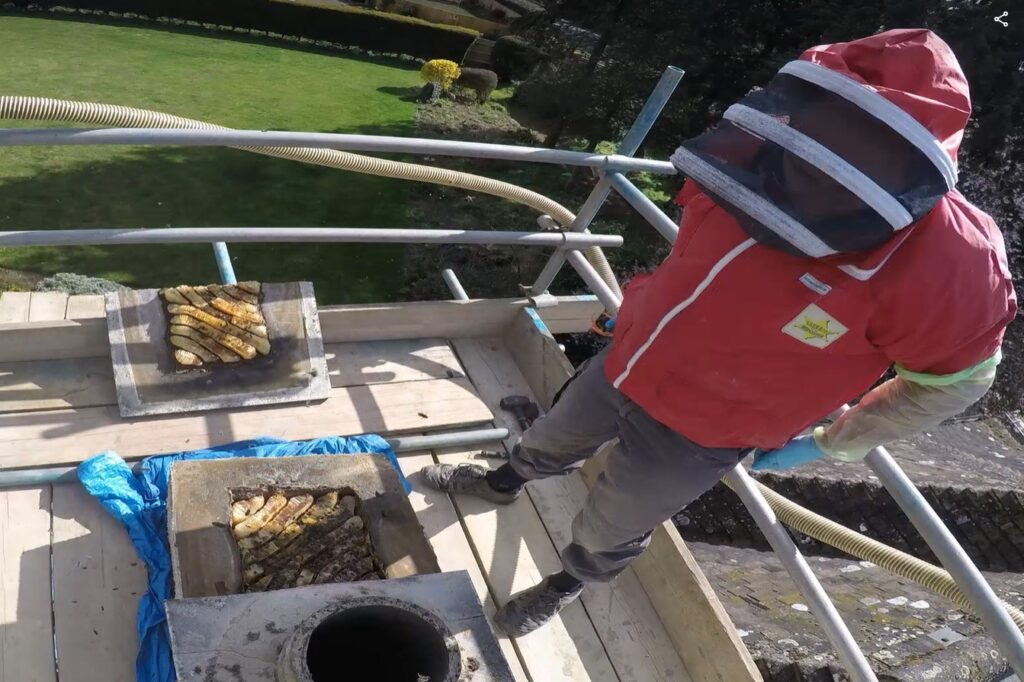
Honey Bees in Chimney
We attend more chimney honey bee removals than we do of any other type of honey bee removal or cutout. We don’t need to dismantle the chimney, we rarely remove more than 4 individual bricks. When honey bees occupy a chimney space it is usually one of three scenarios or a combination of them.
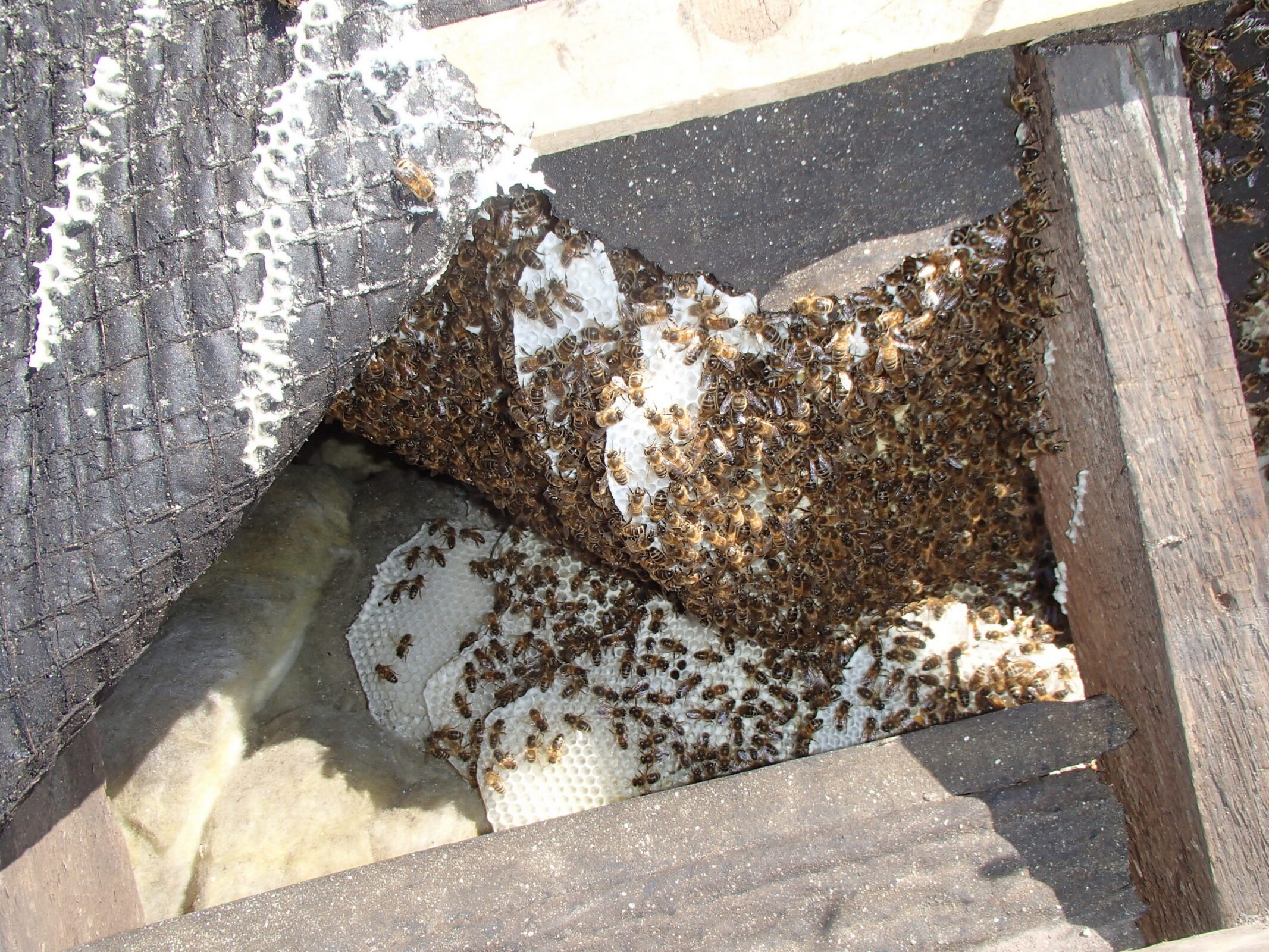
Honey Bees in Roof
Generally speaking honey bees don’t colonise large roof spaces, when they are flying in beneath tiles they more often than not are colonising a cavity wall or an old dismantled chimney stack that is hidden beneath the tiles. But they love dormer windows and flat roofs
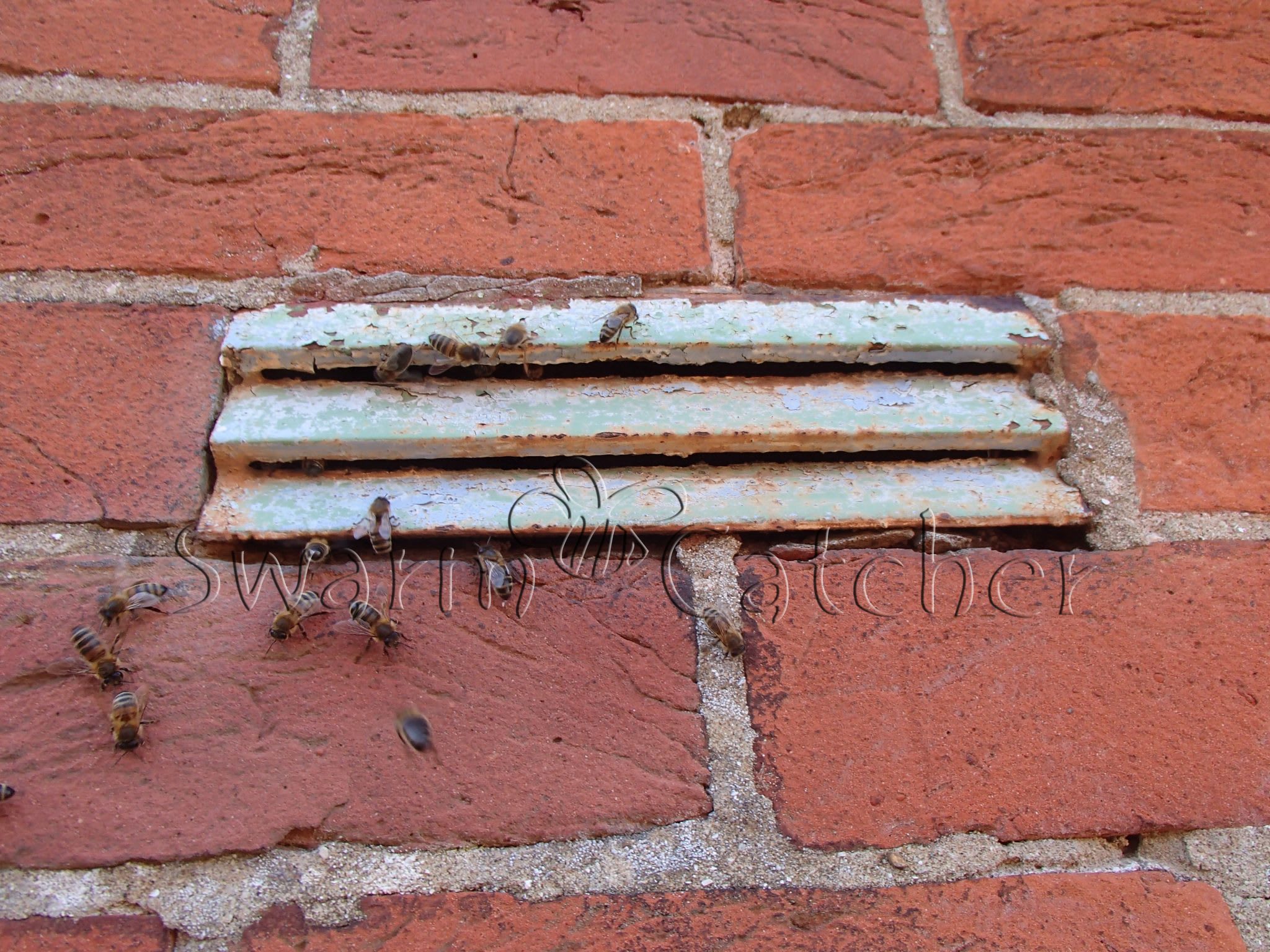
Honey Bees in Wall
We remove bees from walls and we can do it without taking them down or knocking huge holes into them. We remove the bees the wax & the honey. Rarely do we need to remove more than 8 bricks, which we remove whole so they go back as they were.
For further information on bee removal and relocation please use the contact form in the side bar or message button below.
If you are looking for information on removing bees from a chimney check out our article ‘Honey bees in chimney‘, or if you repeatedly have bee swarms take up home in your chimney you may want to look at our page ‘Why honey bees like chimneys‘ & ‘Everything you need to consider when removing bees in a chimney‘ which is a fairly extensive overview.
For information on bee removal and relocation from roofs you may want to look at our page ‘Honey bees in roof‘, or if you have honey bees in a wall our page ‘Honey bees in wall‘ maybe of use.
For examples on removals of honey bees from these and other more unusual places check thru The Hive Blog and investigate our Tag cloud too.
Don’t forget a general overview on honey bee removals which can be found at ‘Live honey bee removal’.
