
Chimneys are the most common place we find honey bees
Honey bees in chimney structures are very common these days.
We attend more live bee removals with honey bees in chimney stacks than we do any other type of live honey bee cut-out removal and relocation – you can see more on this at Why honey bees like chimneys where we explain why honey bees are so attracted to chimneys, and other high locations on properties.
Not sure whether you have honey bees or something else? See our bee nest removal page for identification and next steps.
The most common reason for honey bees being able to colonise a chimney is the poor condition of the flaunching or jointing as a result of weathering (and very often poor material use by not so knowledgeable builders). Bear in mind chimneys take the brunt of the weather and because they are so inaccessible are often overlooked when it comes to maintenance, and when the property is being surveyed for reselling.
If bees have only just entered your chimney in the last few days, early action can save significant cost. See our swarm eviction page.
No need to dismantle the chimney
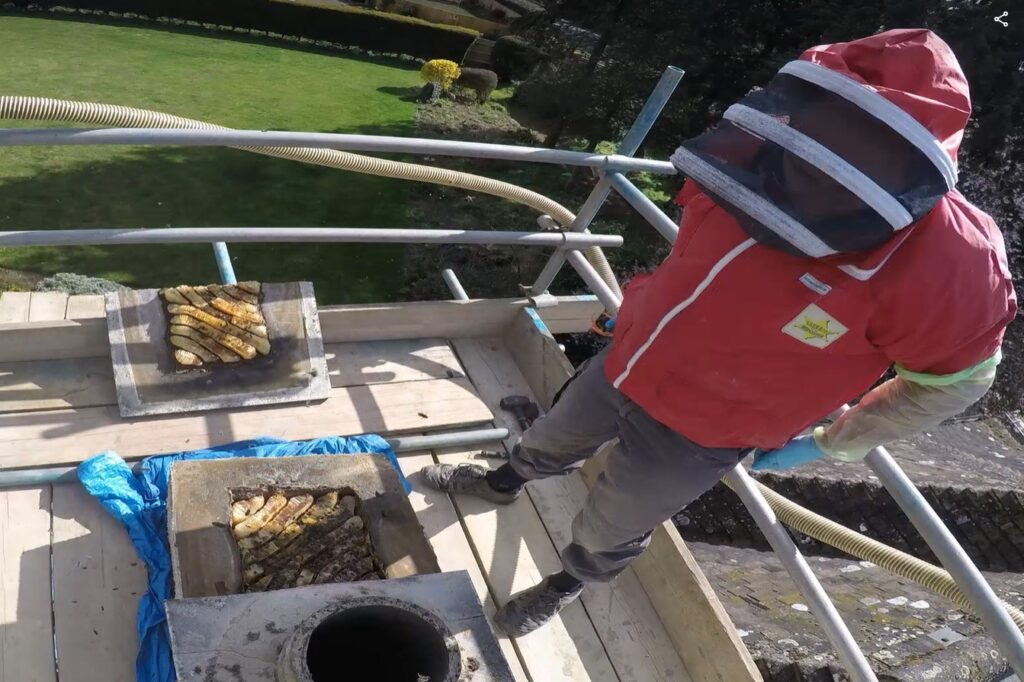
We have never yet needed to dismantle a chimney to remove a colony. In most cases we take off the flaunching and the pot and remove typically 1 or 2 bricks to reach the flue — rarely more than 4, even where the colony extends two metres or more down the space.
When removing “honey bees in chimney” we aim to remove all the bees alive, the comb, the honey, the bees wax and if possible all the detritus. We have not yet needed to dismantle a chimney to do this – not saying we haven’t felt like using a stick of dynamite on the odd occasion, or that it maybe necessary to do sometime in the future, but for now we have not “had to” dismantle a chimney.
In fact these days we rarely need to remove more than 4 bricks even if the colony extends down the space by 2 metres or more, which is quite possible if the bees have been in situ for a couple of years.
When working on a “honey bees in chimney removal” we more often than not need to remove the flaunching and pot to allow proper access to the chimney flue to remove the bees.
We are able to reinstate the pot and flaunching at the end of the job.
This would be an ideal time to have your chimney structure inspected by a chimney expert and have any additional repair work carried out. If the bees have been utilising damaged flaunching (cement top) to access the chimney flue then often it is best to replace the rest of the flaunching at the same time – this is something we can do for you, on completion of the bee removal process.
Very often the pots should be changed at the same time, despite them appearing to be in good condition on removal and reinstatement, they can often crack over the next 12 months or so. A good test to identify the condition of the pot is to give it a tap and listen to it, it should have a clear crisp bell sound.
When we carry out removals of honey bees from chimney’s its usually because they have occupied a chimney space in one of four standard scenarios or some combination of them;
Honey bees in chimney liner space

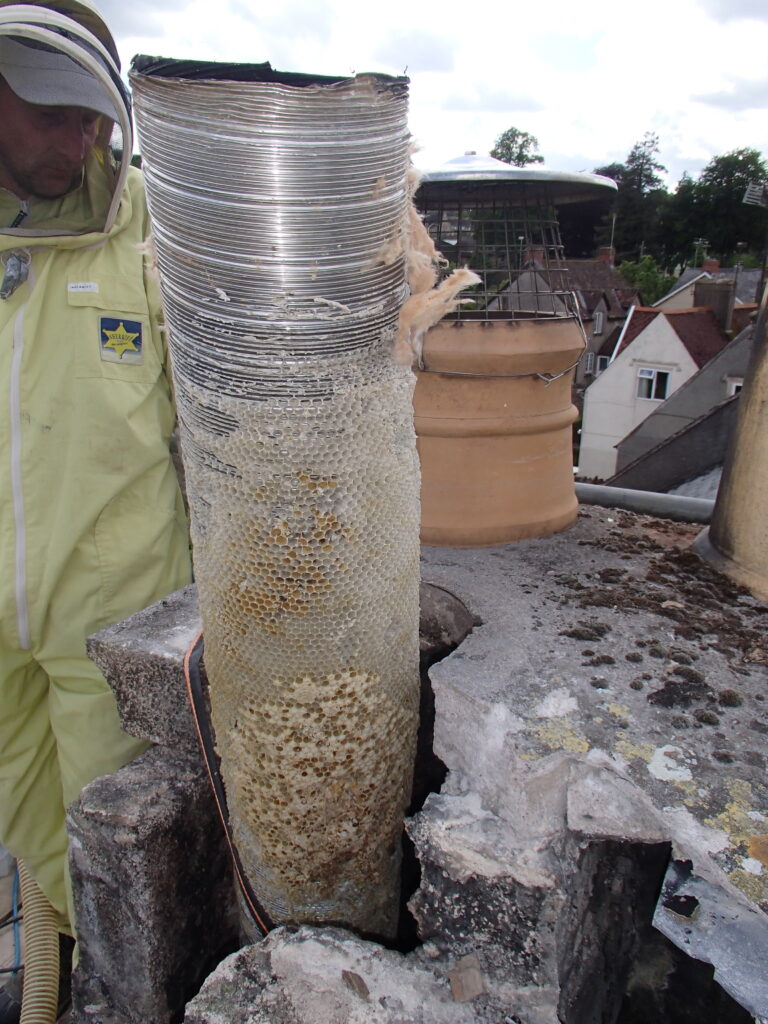
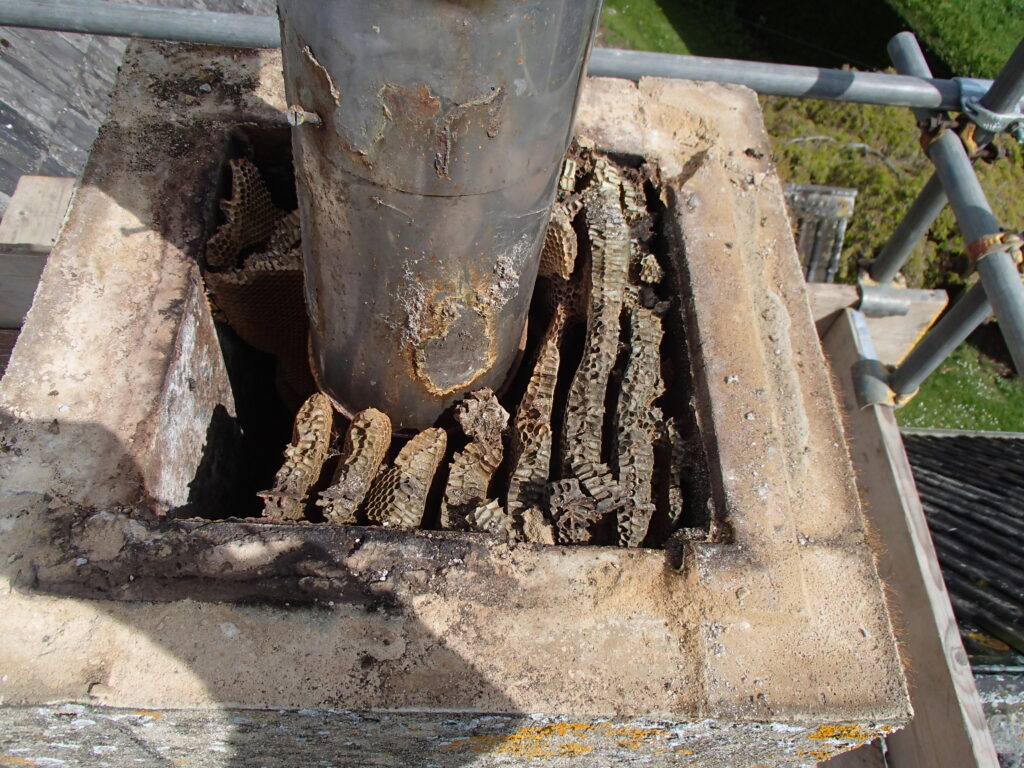
Often bees will find their way between a gas flue liner or solid fuel burner flue liner and the original chimney, more often than not it’s the space between the gas flue and the original chimney. These liners tend to be flexible steel liners, rigid metal liners or concrete flue liners. Often if the liner is a rigid metal or concrete flue liner the bees nest can be removed without having to do anything with the liner, unfortunately if the liner is a flexible flue liner it usually needs to be removed. There’s lots of reasons for this and they are all for your health and safety. Obviously there are occasions when this is not the case mostly to do with the length of time the bees have been in situ.
In all instances that a gas liner may need to be removed we suggest talking to your local Gas Safe Register certified registrant about the likelihood of the heat appliance needing to be decommissioned and removed so that we can carry out the task of removing the bees from the chimney, after which the certified registrant can reinstate and recommission the appliance.
We recommend that you arrange for this to be done yourselves to keep costs to a minimum, but can advise you on the need for this if required and if necessary arrange it on your behalf.
If there’s a flue liner for a wood, oil or multi-fuel stove in the chimney then once we have removed the honey bees in chimney stack (ready for relocation) the flue liner and stove connection should be inspected by the appropriate scheme registrant before the appliance is used.
Obviously there are occasions when this is not needed, mostly to do with the length of time the bees have been in situ, but you need to be aware of the possibility of this being necessary.
No longer used open chimney space, capped or not

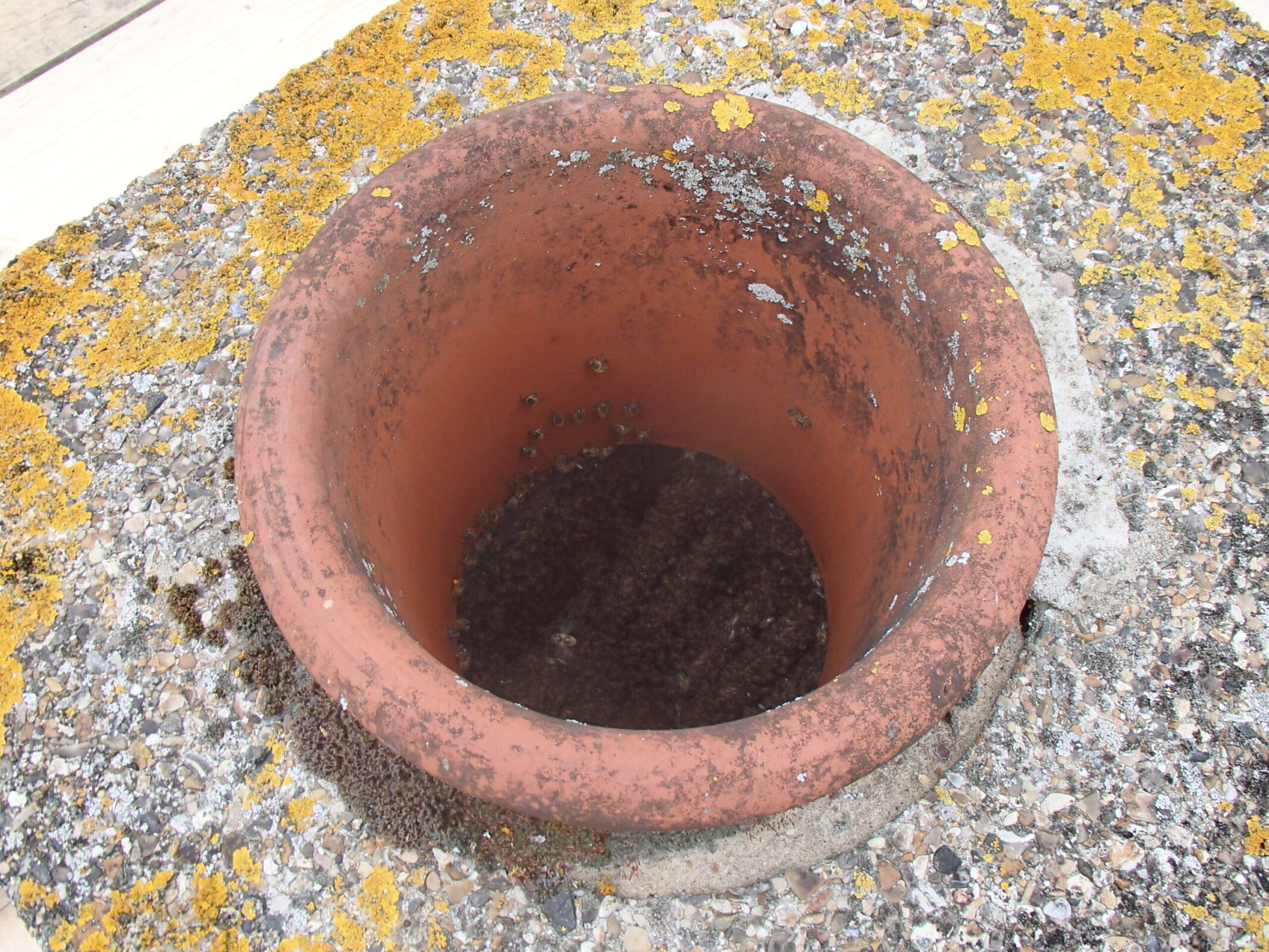
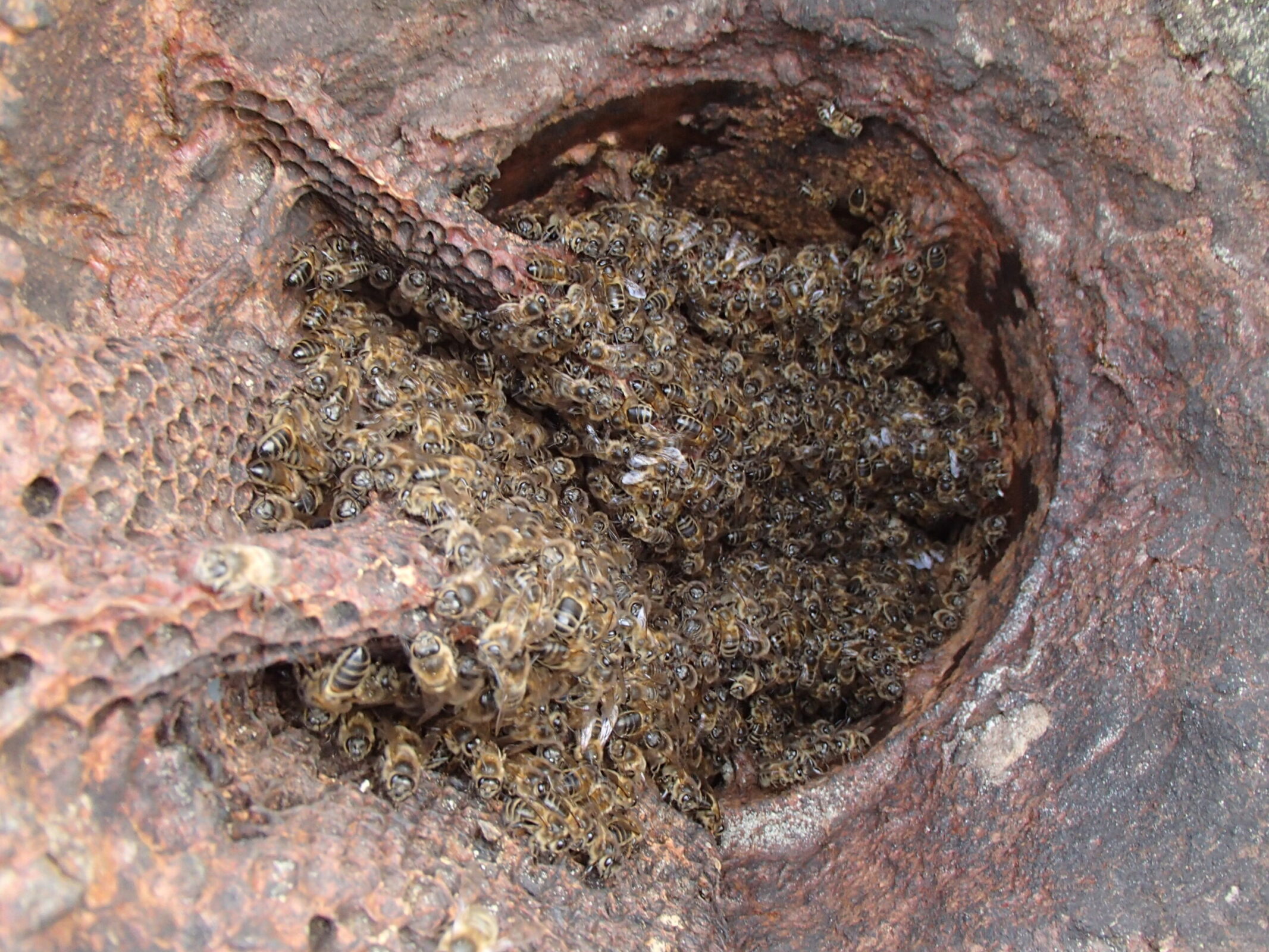
Honey bees will also colonise an unused open chimney space that has either been capped to allow the chimney to breathe (these are rarely designed to keep wasps and bees from setting up home) or left uncapped, allowing rain and anything else access. It is not that common for honey bees to occupy a chimney that does not have some sort of cover unless there is a substantial lip beneath the pot. This is because they need to be able to attach and hang comb from something. When we do come across this situation there is often some wire mesh on the top of the pot – intention of which is probably to prevent birds nesting particularly jackdaws.
Vented sealed chimney flues
A chimney sealed at the top but left vented still gives the bees a way in: the vent or airbrick that lets the flue breathe is big enough for them to pass through, and the colony builds in the sealed space behind it.

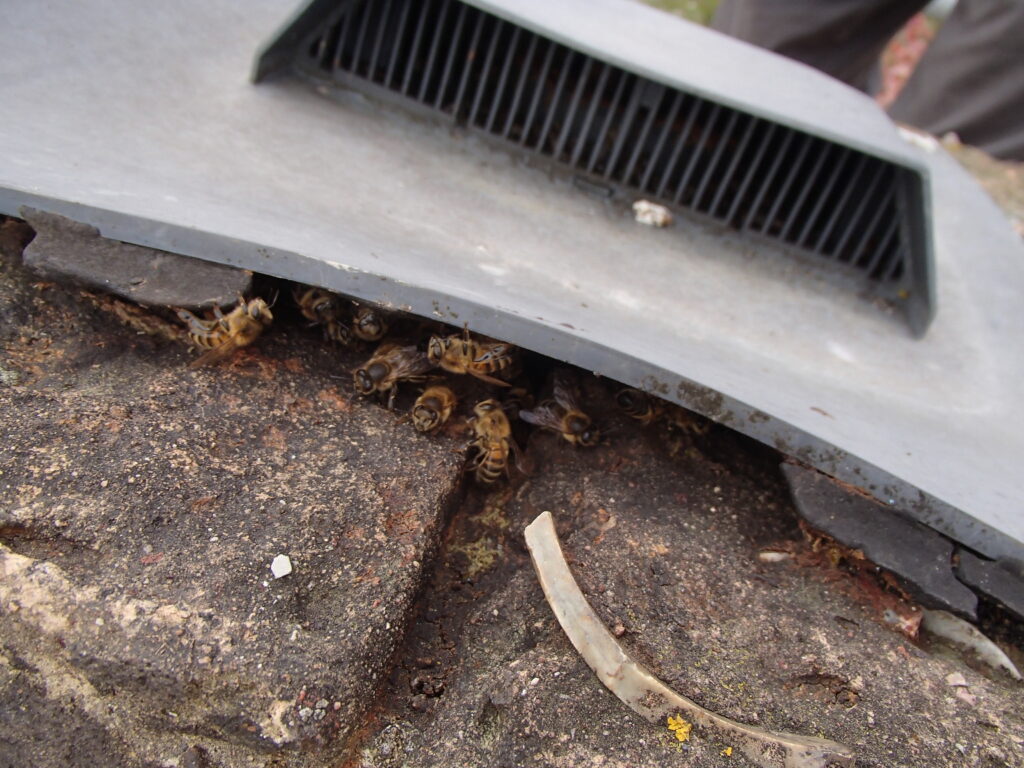
No longer used sealed chimney
We also go to a lot of chimneys that have been sealed over with a flag stone or completely flaunched. The honey bees are usually gaining access to the chimney space because of the effects of weathering on the flaunching or poor quality mortar mix. In these cases we always recommend that you discuss how you reinstate the chimney with your chimney sweep as most disused chimneys should be allowed to breath as well as be capped to prevent water ingress or further infestations of honey bees or wasps.
For a lot more detailed info about “honeybees in chimney” please see our page Removing bees in a chimney where we discuss the subject further.
Commercial & Public Sector Properties
Honey bees in chimneys are common on commercial and public buildings – schools, churches, estate properties, housing stock.
If you manage or maintain buildings with older chimney stacks, the same weathering and flaunching issues apply but the procurement and access requirements are different.
We provide formal cost indication documents compatible with purchase order processes, work within your site’s induction and permit-to-work requirements, and can liaise directly with your scaffolding contractor on access specification. See our Commercial & Public Sector page for full details.
Bees coming down into the fireplace
Bees coming into the room through the fireplace are shut out with dark, heavy-duty plastic sheeting taped over the opening — they are drawn to light, so thin or pale material only draws them further down the flue — and no fire should be lit while a colony is in the chimney.
Immediate action while waiting for removal:
Heavy-duty plastic sheeting over the fireplace opening:
Rockwool or mineral wool in the flue:
Do not light a fire:
If bees are present in a chimney the bees may be reoccupying an old nest – melting wax and honey is a fire hazard – a fire is likely to cause the bees to drop to bottom of the flue en masse.
See our page on Smoking Bees Out for full detail on the risks.
Common questions
No. In most cases we only need to remove the flaunching and chimney pot, and typically 1-2 bricks to access the flue. We do not dismantle chimneys – the removal is targeted to the minimum access needed.
We aim to remove all the bees alive, the comb, honey, and any detritus.
The bees are relocated to our apiary.
On completion either we or your builder reinstate the brickwork and flaunching.
Honey bees often build nests in chimneys because of faults in the flaunching – weathering damage, cracks from frost, or previous work that didn’t consider bee entry points. Chimneys provide the dark, enclosed cavity bees look for when choosing a nest site.
We can carry out straightforward repairs to flaunching and some pointing if we have sufficient time on the day. We know chimneys well from more than 15 years of removing bees from them, but we are honest about the limits of what we do. Sometimes the chimney needs inspection or specialist repair work – particularly repointing with lime mortar on heritage structures – and we will tell you when that applies. You can also use your own builder, which is often less expensive for more involved work.
Not always. We can advise on what’s actually needed once we see the condition of the existing flaunching. If a patch repair is sufficient we can carry out that work on the day providing we have sufficient time. If the whole flaunching needs replacing, proper installation requires an additional day or two for the mortar to cure correctly. For full replacement work we recommend using a local builder who can do the job properly over the appropriate time period rather than it being rushed, and check all is good before the scaffold comes down.
Often yes, even if the pot appears sound when removed. Pots that look intact can crack over the following 12 months. A good test: tap the pot and listen – it should have a clear crisp bell sound. A dull thud indicates hairline cracks.
For disused flues, we fit a cap that allows the chimney to breathe while preventing bee and water ingress – typically costing less than £35 per pot (in 2025). The flue must be ventilated to prevent damp and condensation. For live flues, any mesh fitted must comply with Building Regulations – mesh fine enough to exclude bees must not be used on a live solid fuel flue as it contravenes regulations and is dangerous.
Honey bees often colonise the space between a flue liner and the original chimney. Rigid metal or concrete liners can usually remain in place during removal. Flexible flue liners typically need to be removed for safety reasons. In all cases involving a gas appliance, a Gas Safe registered engineer should decommission the appliance before the bee removal and reinstate it afterwards.
Yes. Chimney caps designed to allow ventilation are rarely designed to exclude bees – a gap of just 6mm is enough for honey bee access. Chimneys sealed with flagstone or flaunching are also vulnerable where weathering has opened gaps in the mortar. We regularly remove colonies from chimneys that owners believed were sealed.
No. Building Regulations Section J paragraph 3.25 requires a minimum mesh size of 6mm on solid fuel flue terminals. This is larger than the 5.5mm needed to exclude bees. Any mesh fine enough to exclude bees from a live solid fuel flue contravenes building regulations and creates a dangerous blockage risk. For gas appliances, smaller mesh may be possible but requires consultation with the cowl manufacturer to avoid voiding warranties and creating liability issues.
Cost depends on how long the colony has been established, the chimney configuration, and what access is required. A recently arrived swarm can often be evicted at a fixed price. An established colony is priced on a day rate basis, with a cost indication provided once we understand your specific situation. We rarely need a site visit to provide an accurate cost indication – photos and details submitted via our contact form are usually sufficient.
See our pricing page for a full breakdown.
Most assessments are done from your photos and description at no charge. Where a site survey is needed, its cost depends on distance, urgency and whether an overnight stay is involved, and a good percentage of it is normally offset against the work.
For a more lot more detailed info about “honeybees in chimney” please see our page Removing bees in a chimney where we discuss the subject again in more detail.
Our honey bee relocation Specialist is waiting for you!
Swarmcatcher are the UK honey bee colony removal specialists that provide an ethical eco-friendly bee removal and relocation service across the UK.

Honey Bees in Chimney
We attend more chimney honey bee removals than we do of any other type of honey bee removal or cutout. We don’t need to dismantle the chimney, we rarely remove more than 4 individual bricks. When honey bees occupy a chimney space it is usually one of four scenarios or a combination of them.
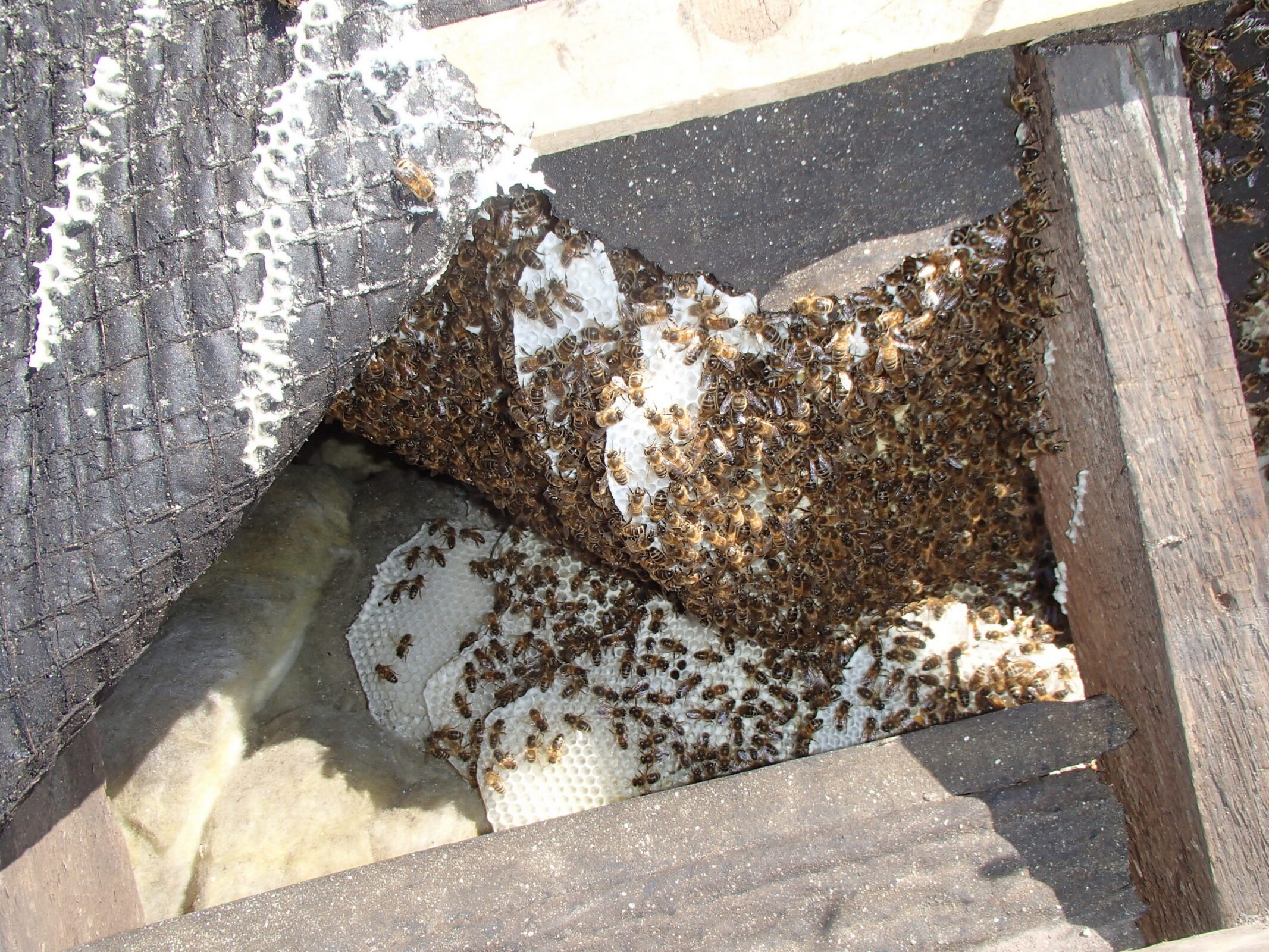
Honey Bees in Roof
Generally speaking honey bees don’t colonise large roof spaces, when they are flying in beneath tiles they more often than not are colonising a cavity wall or an old dismantled chimney stack that is hidden beneath the tiles. But they love dormer windows and flat roofs
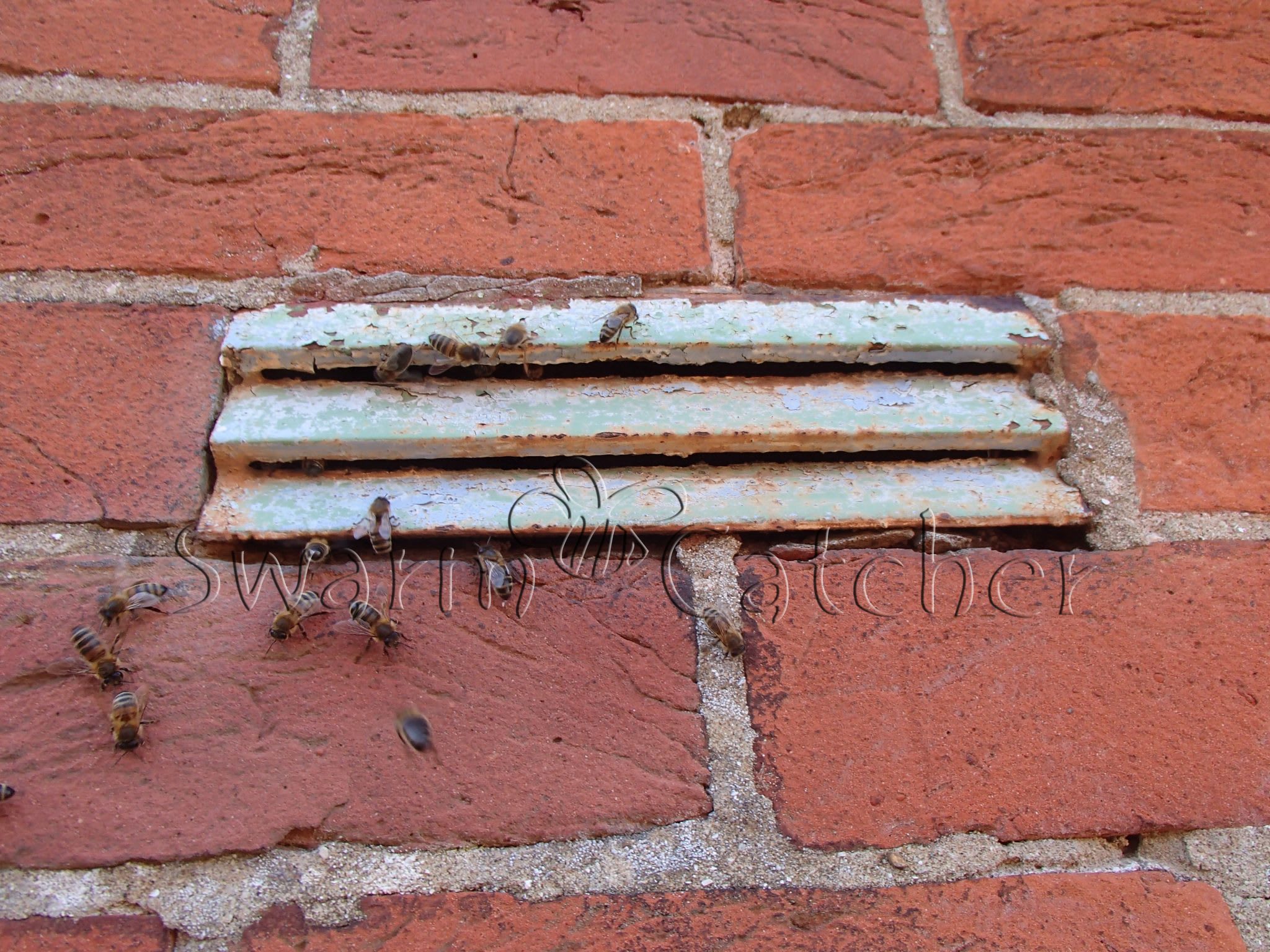
Honey Bees in Wall
We remove bees from walls and we can do it without taking them down or knocking huge holes into them. We remove the bees the wax & the honey. Rarely do we need to remove more than 8 bricks, which we remove whole so they go back as they were.
For further information on bee removal and relocation please use the contact form in the side bar or message button below.
If you are looking for information on removing bees from a chimney check out our article ‘Honey bees in chimney‘, or if you repeatedly have bee swarms take up home in your chimney you may want to look at our page ‘Why honey bees like chimneys‘ & ‘Everything you need to consider when removing bees in a chimney‘ which is a fairly extensive overview.
For information on bee removal and relocation from roofs you may want to look at our page ‘Honey bees in roof‘, or if you have honey bees in a wall our page ‘Honey bees in wall‘ maybe of use.
For examples on removals of honey bees from these and other more unusual places check thru The Hive Blog and investigate our Tag cloud too.
Don’t forget a general overview on honey bee removals which can be found at ‘Live honey bee removal’.
