
Bee Nest Removal
Not many bee nests are as visible as this one – when honey bees nest inside a building the colony is hidden within the cavity, often with no external sign beyond a small stream of bees at the entrance.
If you have found bees nesting in your property – chimney, wall cavity, roof, soffit or somewhere else – this page will help you work out what you are dealing with, whether it needs acting on, and what the options are.
We are SwarmCatcher. We have spent 20+ years removing and relocating honey bee colonies from buildings across England, Scotland and Wales. We remove the bees alive, remove all the wax, honey and detritus, reinstate what we opened up and proof the entry point against reinfestation. That is all we do – we are not a general pest controller, not a franchise and not a call centre.
What we can also do – before you spend any money – is help you understand your situation. Not every bee problem needs a removal. Not every removal needs us. And not every insect coming and going from your building is a honey bee.
Not sure what you are dealing with?
Send us photos and a brief description.
We will tell you what you have,
whether it needs acting on,
and what the realistic options are
no charge, no obligation.
Is It Actually a Honey Bee?
This is the first question that matters, it determines everything that follows. We regularly receive enquiries about insects that turn out to be bumble bees, solitary bees, wasps or hoverflies – all of which are dealt with differently.
Honey bees are slim, golden-brown to dark brown, roughly 12–15mm long, and fly purposefully in a steady stream to and from a specific point on the building. If you watch for a few minutes you will see bees arriving and departing from the same gap, crack or hole – and if the colony is established, you may see bees carrying pollen on their back legs as they return.
Bumble bees are larger, rounder and noticeably furry. They nest in small colonies – often in bird boxes, under decking or in old mouse nests in the ground. They have an annual lifecycle and the nest will naturally die off by autumn. In most cases bumble bee nests do not need removing and should be left alone.
Solitary bees – including mason bees, leafcutter bees and mining bees – nest individually rather than in colonies. You may see dozens of them around a south-facing wall, or in a flowerbed, but each is working alone. They do not build honeycomb, they do not produce honey, and they cause very little structural damage. They do not need removing usually.
Wasps are brighter yellow with distinct black markings and a more aggressive flight pattern. Wasp nests are a pest control matter – we do not deal with wasps.
If you are not sure, send us a photo via the enquiry form. We will tell you what you have.
→ Bee identification – more detail
What Are You Seeing? Common Signs of a Honey Bee Nest
People find honey bee nests in different ways. Sometimes the bees are obvious – a cloud of them arriving at a chimney pot or a wall vent. Other times the signs are more subtle. Here is what each symptom usually means.
A sudden appearance of bees at a specific point on the building – large numbers arriving at a gap, crack or hole over a few hours or days. This is usually a swarm that has just moved in. This is the point at which action is cheapest and simplest. See our Urgent Swarm Eviction page.
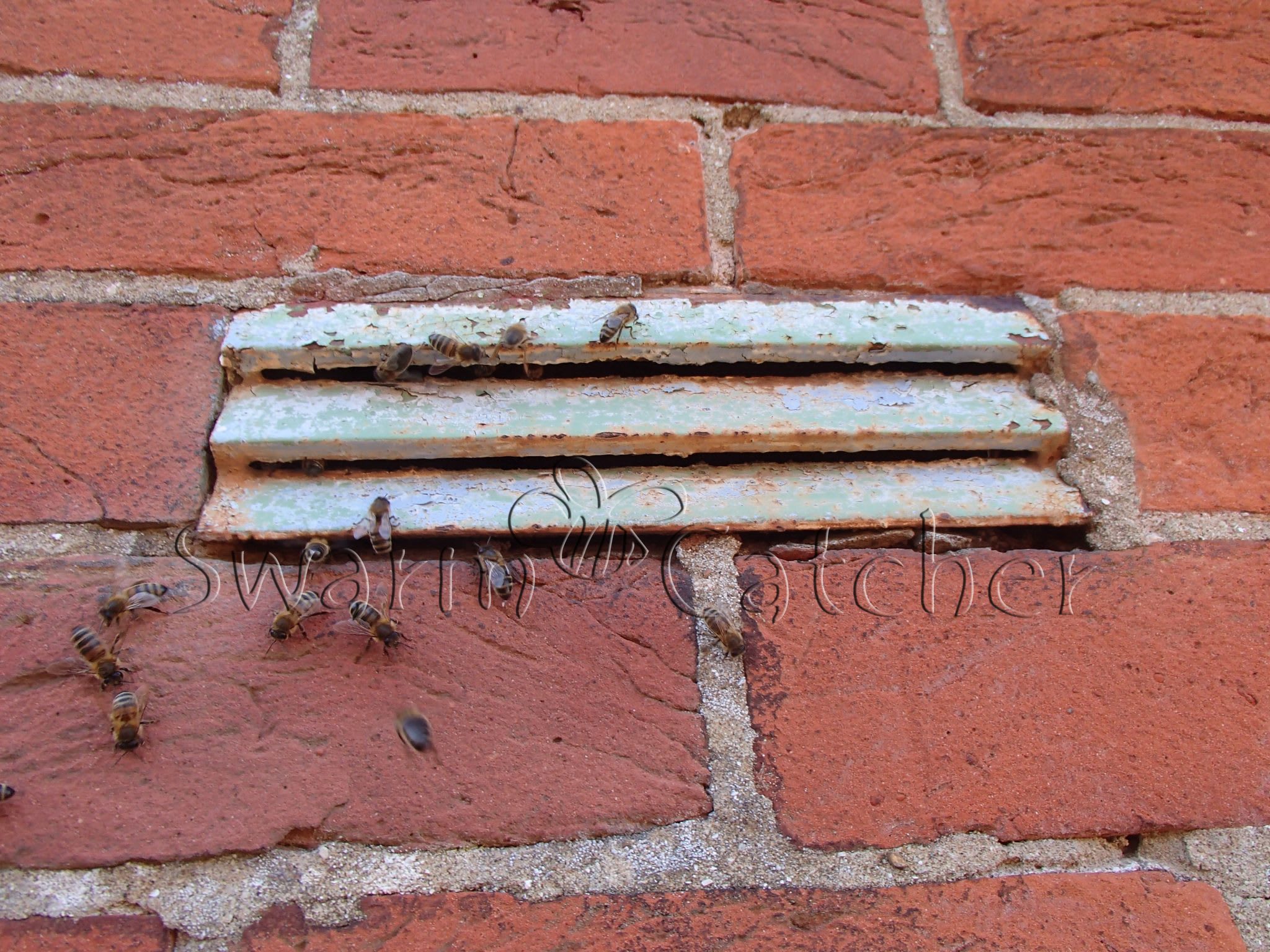
A steady stream of bees coming and going from a gap in the brickwork, an air brick, a weep hole or beneath roof tiles – this is an established colony. The bees have been there for weeks, months or possibly years. They have built comb, are raising brood and storing honey. This requires a full removal.
Dark staining around a small hole or gap in the wall or brickwork – the staining is propolis, wax and general traffic wear from thousands of bees passing through the entrance over time. This is a reliable indicator of an established colony rather than a recent arrival.
Bees carrying pollen on their back legs as they return to the entrance – pollen being carried in means brood is being raised inside. The colony has established and the queen is laying. This is not a swarm that might move on.
Buzzing or humming audible through an internal wall, ceiling or chimney breast – you are hearing the colony inside the cavity. The sound can be surprisingly loud, particularly on warm days when the colony is active. The bees are established and present in significant numbers.
Honey appearing on an internal wall, ceiling or around a fireplace – honey is leaking from the comb inside the cavity. This happens when comb collapses due to heat, when the weight of honey stores exceeds what the comb can support, or when a colony has died and the comb is no longer being maintained. This needs acting on – honey leaking through a structure attracts secondary pests including wax moth, carpet beetle and ants, and can cause significant staining and damage.
Bees appearing inside the house – in a room, coming from a fireplace, appearing at a window – the bees have found a route from the cavity into the living space. This is more common in chimney colonies where the register plate or fireboard is not sealed, but can happen with wall cavities too. The colony needs removing.
Where Honey Bees Nest within Buildings
We are told honey bees need a cavity of roughly 20 to 100 litres with a small entrance – ideally just large enough for one or two bees to pass through at a time. Buildings offer these conditions in several places, and the location affects how the removal is carried out, what access is needed and what it costs.
Textbooks suggest bees prefer cavities of 45 to 100 litres. In practice the colony will manage its size to suit the available space. We regularly remove colonies from chimney flues exceeding 120 litres in size, but the bee nest will get to a maximum size at which point it will not expand further. So a bees nest is never going to fill your chimney flue – they regulate their own growth. The only times we see a colony that has expanded beyond its natural limits is when it has been previously poisoned and recolonised, with successive layers of comb built away from the old remains.
Chimneys are the most common location we deal with. The warm, sheltered flue space is an ideal nesting site, and bees typically enter via the pot, a gap in the flaunching or through damaged brickwork near the top of the stack. Chimney removals are our most frequent job – we rarely need to remove more than two bricks.
→ Full detail: Honey Bees in Chimney
Wall cavities – bees will exploit surprisingly small gaps to access a wall cavity. A crack in a mortar joint, an unsealed air brick, a weep hole, a gap where an old pipe or bolt has been removed – the size and shape of the gap both matter, and a 5mm gap can become 6mm over a season as mortar degrades or bees work at the edges. We regularly find dead drones accumulated behind air bricks – the workers pass through comfortably but the larger drones cannot get back out. The colony builds comb within the cavity, often extending vertically over a surprising distance. Wall removals are carried out with minimal disruption – we see it as akin to keyhole surgery.
→ Full detail: Honey Bees in Walls
Roofs and soffits – bees entering beneath tiles, through soffit vents or at the junction between wall and roof are usually colonising a specific void rather than the entire roof space. Flat roofs and dormer windows are particularly common locations.
→ Full detail: Honey Bees in Roof
Other locations – we have removed colonies from floor voids, behind fascias, inside meter boxes, within church towers, inside electrical substations and from structures that defy easy description. If honey bees have found a cavity in a building, we have almost certainly dealt with a similar scenario.
One question we hear regularly is “why my property?”
Honey bee swarms rarely establish a new nest closer than 300 metres from the original colony, so the source is rarely your immediate neighbour. The answer is usually simpler – an unmaintained chimney pot, a crumbling mortar joint, an unsealed air brick or a gap beneath a loose tile. The bees are not choosing your property specifically. They are choosing the first suitable cavity they find, and an unmaintained building offers more of them.
Has the Colony Just Arrived – or Has It Been There for Months?
This is the single most important factor in determining cost, complexity and urgency. A recently arrived swarm and an established colony are fundamentally different jobs.
A recently arrived swarm – within the last few days to two weeks – has no built comb, no honey stores and no deep attachment to the space. A swarm eviction at this stage is the simplest, quickest and least expensive scenario. We can often offer a fixed price covering the removal and proofing. MEWP (cherry picker) access is usually sufficient, which can be arranged within days and costs a fraction of scaffold.
An established colony – present for weeks, months or years – has built comb, is raising brood, storing honey and has thoroughly marked the cavity with scent. This requires a full removal: extracting the colony, all the comb, all the honey and all the detritus, then reinstating and proofing. Scaffold is the standard access method for established colonies at height, and the job is priced on a day rate basis.
The longer a colony has been present, the more complex and more expensive the removal becomes. Acting early is the single most effective way to reduce cost.
Swarm just arrived?
If bees have entered your building within the last few days, see our Urgent Swarm Eviction page. The longer you wait, the more complex and expensive the job becomes
What Happens If You Leave a Honey Bee Nest in a Building?
Leaving a honey bee colony in a building does not resolve the problem – it compounds it. Here is what actually happens over time, based on what we see regularly across hundreds of jobs.
The colony grows. A healthy colony can contain 40,000 to 60,000 bees at peak season. The comb extends further into the cavity. Honey stores increase – in a good year a colony can store 30kg or more of honey within a wall or chimney, and we have removed over 85kg from a single roof cavity. That weight is supported by wax attached to the inside surfaces of the structure.
The colony swarms. Once established, a colony will typically swarm at least once a year – the old queen leaves with half the colony to find a new home. The daughter queens that remain may also produce casts (secondary swarms). Each swarm that leaves the building will attempt to colonise another cavity nearby, and the remaining colony continues in the original location.
Honey leaks. Warm weather softens the wax comb. The weight of honey stores pulls on the weakened wax. Comb collapses. Honey runs through the cavity and appears on internal walls, ceilings or around fireplaces. Honey damage to plaster, timber and decoration can be extensive and expensive to repair.
Secondary pests arrive. Wax moth, carpet beetle, clothes moth and ants are all attracted to the wax, honey and dead bees associated with a colony – whether the colony is alive or has died naturally. These secondary infestations can persist long after the bees themselves have gone.
The scent remains. Even if a colony dies out over winter – which does happen – the wax, propolis and queen pheromones remain in the cavity for years. The following spring, scout bees from another colony will detect the scent and investigate. The same cavity is recolonised. The cycle repeats, year after year, and each successive colony makes the eventual removal more complex.
How We Assess and Price
Most bee removal contractors charge for a site survey before they can give you a price. We rarely need to visit site.
Our enquiry process gathers the specific information we need to assess your job. Our structured diagnosis form walks you through the key questions – photos of the bee entrance, photos showing the full height of the property, the address, how long the bees have been present, and any known access constraints. We look at the property on Google Maps as part of our assessment. In most cases this gives us enough to provide an accurate cost indication without anyone needing to visit.
This saves you time and cost. It also means we can respond quickly, which matters when a recently arrived swarm needs acting on before the window for low-cost eviction closes.
What we provide: A written cost indication showing the likely scope of the job – whether it is a one-day or two-day removal, what access method is required, and what the total cost is expected to be. Access costs such as MEWP or scaffold hire are indicated separately and always discussed upfront. There are no hidden extras.
What we need from you: Clear photos of where the bees are entering the building. A photo showing the full height of the property and the ground in front. The full address. How long the bees have been present. Any known access constraints.
Get a cost indication
Submit your details and photos via our enquiry form.
We will come back to you with a written cost indication
no obligation, no site visit charge.
What Is Included in a Bee Nest Removal
Our removal covers the entire colony and everything associated with it.
The bees – the entire colony including the queen is captured alive and relocated to our apiary. We do not use pesticides or extermination methods. This is live removal and relocation.
The comb – all wax comb is removed from the cavity. Leaving comb behind attracts wax moth, carpet beetle and robber bees from other colonies – and creates a food source for secondary pests that can persist for years.
The honey – all honey stores are removed. Honey left in a cavity will eventually leak as wax degrades, and in the meantime it attracts ants, wasps and other insects.
The detritus – dead bees, cocoon material, propolis deposits and other waste associated with the colony are cleaned out.
Reinstatement – we replace any bricks or access points we removed, cap redundant flues where appropriate, and carry out straightforward repointing where lime mortar is not required.
Proofing – the entry point is proofed against reinfestation. This is carried out on every job regardless of how quickly the colony was removed, because scent marking begins from day one. Without proofing, the same entry point will attract a new swarm the following season.
→ Full detail on proofing, reinstatement and guarantees
→ Pricing – how we price and what affects cost
Why the Removal Method Matters
Not all bee nest removals are equal, and the consequences of a bad removal can cost more than the original job.
Poisoning – some pest controllers will spray insecticide into the entrance and leave. The bees die. The comb, honey and thousands of dead bees remain inside the cavity. The honey leaks. Wax moth colonises the comb. Carpet beetle and clothes moth breed in the dead bees. The contaminated honey cannot be safely left in place, and the entire nest eventually needs extracting anyway – now with the added complication of toxic residue. We have been called to numerous properties to remove previously poisoned nests because of dripping honey, secondary pest infestations or persistent odour.
Incomplete removal – removing the bees but leaving the comb and honey behind creates a food source for secondary pests and, once the comb degrades, a honey leak. The residual scent also ensures the cavity will be recolonised the following season.
No proofing – removing everything but failing to proof the entry point means another swarm will find the same location. The scent from wax and propolis persists for years. We see this regularly – a properly executed removal followed by no proofing, and twelve months later there are bees in the same place.
Excessive structural damage – we regularly see photographs of chimney stacks dismantled to the roofline, walls with twenty or thirty bricks removed, and openings far larger than the job required. We rarely need to remove more than four bricks for a chimney removal. The skill is in knowing which bricks to remove, not how many.
→ More on removal methods
→ Why poisoning bees creates more problems than it solves
National Coverage
We carry out bee nest removals from all types of buildings across England, Scotland and Wales – residential, commercial, heritage, listed, industrial and public sector properties. We are fully insured for all property types including Grade I and Grade II listed buildings.
We hold IPAF & PASMA certification for working at height, are full members of the BPCA (British Pest Control Association) and carry comprehensive public liability insurance.
For commercial and public sector organisations – councils, heritage bodies, facilities managers, estates teams – we provide site-specific RAMS, formal cost indication documents for purchase order processing, and full documentation packages.
FAQ’s
It depends on the job. A recently arrived swarm can often be evicted at a fixed price. An established colony removal is priced on a day rate basis. We provide a written cost indication once we understand your specific situation – send us photos and details via the enquiry form.
In most cases no. Our enquiry process gathers the information we need to assess the job remotely – photos, address, how long the bees have been present. We will tell you if a site visit is needed and explain why.
No. We capture and relocate the entire colony alive – including the queen – to our apiary. We do not use pesticides or extermination methods. If we suspect a colony is diseased we will deal with it responsibly rather than risk spreading disease to other colonies.
Without proofing, yes – the scent from the original colony persists for years and attracts new swarms to the same entry point. We proof every job as standard, which significantly reduces the risk of reinfestation.
A beekeeper can collect a swarm from a branch or bush. Once bees have entered a building cavity, few beekeepers have the equipment, insurance or structural knowledge to deal with it correctly. Swarm collection and live removal from within a building are fundamentally different jobs.
You are hearing a honey bee colony inside the wall cavity. The sound can be surprisingly loud. The colony is established, the queen is laying, and the bees are present in significant numbers. This requires a removal – it will not resolve itself.
The comb inside the cavity has collapsed or degraded, and honey is leaking through the structure. This needs acting on – honey leaking through plasterwork causes staining and damage, and attracts secondary pests. Contact us with photos via the enquiry form.
A swarm eviction of a recently arrived colony can often be completed in a few hours. An established colony removal is typically a full day, occasionally extending to a second day for large or complex jobs. We will tell you what to expect in the cost indication.
Yes. Proofing of the entry point is included as standard on every job. This is essential regardless of how quickly the colony was removed, because scent marking begins from day one.
In the first day or two after a swarm arrives, it is not unreasonable to watch and see whether they commit to the space. After 48 hours usually they have settled. Waiting beyond that point serves no useful purpose – the colony will grow, the removal will become more complex and more expensive, and even if they eventually die out naturally, the scent remains and attracts another colony the following season.
Honey bee swarms rarely establish a new nest closer than 300 metres from the original colony, so the source is rarely your immediate neighbour. The answer is usually simpler – an unmaintained chimney pot, a crumbling mortar joint, an unsealed air brick or a gap beneath a loose tile. The bees are not choosing your property specifically. They are choosing the first suitable cavity they find, and an unmaintained building offers more of them.
Get Help With Your Bee Problem
Whether you have a swarm that has just arrived, an established colony that has been there for years, or you are not sure what you are dealing with – send us photos and details via the enquiry form. We will tell you what you have, what the options are and what it is likely to cost. No obligation, no pressure.
Get Help With Your Bee Problem
Whether you have a swarm that has just arrived,
an established colony that has been there for years,
or you are not sure what you are dealing with
send us photos and details via the enquiry form.
We will tell you what you have,
what the options are and what it is likely to cost.
no obligation, no site visit charge.

Honey Bees in Chimney
We attend more chimney honey bee removals than we do of any other type of honey bee removal or cutout. We don’t need to dismantle the chimney, we rarely remove more than 4 individual bricks. When honey bees occupy a chimney space it is usually one of three scenarios or a combination of them.
Honey Bees in Roof
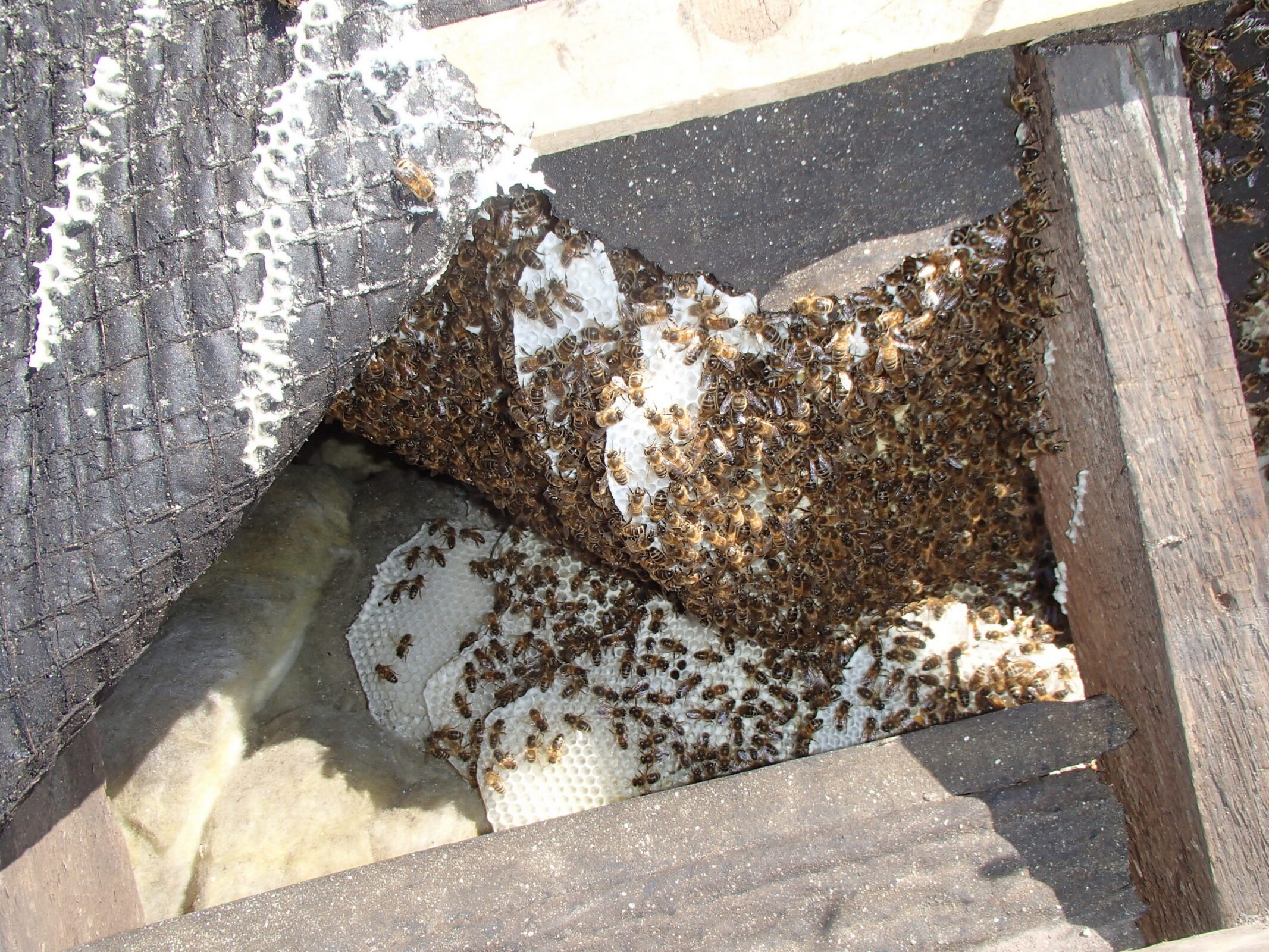
Generally speaking honey bees don’t colonise large roof spaces, when they are flying in beneath tiles they more often than not are colonising a cavity wall or an old dismantled chimney stack that is hidden beneath the tiles. But they love dormer windows and flat roofs
Honey Bees in Wall
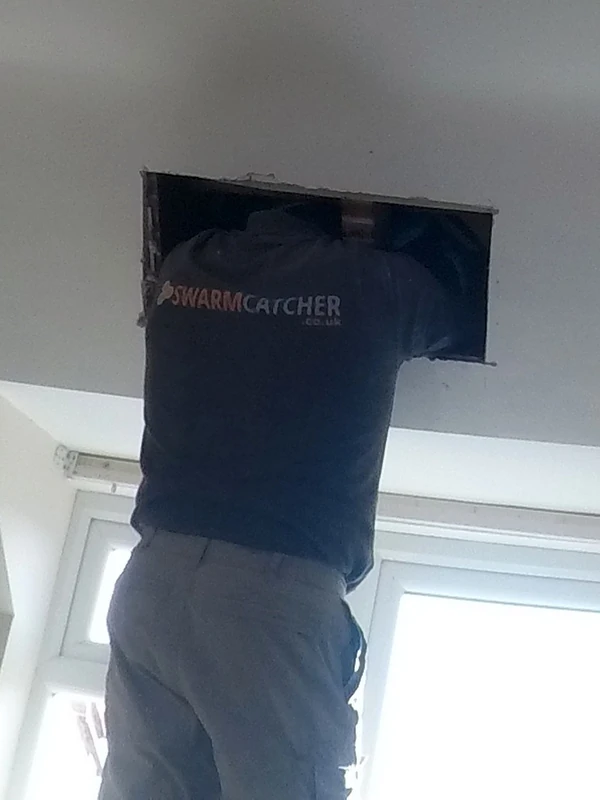
We remove bees from walls and we can do it without taking them down or knocking huge holes into them. We remove the bees the wax & the honey. Rarely do we need to remove more than 8 bricks, which we remove whole so they go back as they were.
For further information on bee removal and relocation please use the contact form in the side bar or message button below, or CALL 01297 441272 to speak to someone local who knows all about it.
If you are looking for information on removing bees from a chimney check out our article ‘Honey bees in chimney‘, or if you repeatedly have bee swarms take up home in your chimney you may want to look at our page ‘Why honey bees like chimneys‘ & ‘Everything you need to consider when removing bees in a chimney‘ which is a fairly extensive overview.
For information on bee removal and relocation from roofs you may want to look at our page ‘Honey bees in roof‘, or if you have honey bees in a wall our page ‘Honey bees in wall‘ maybe of use.
For examples on removals of honey bees from these and other more unusual places check thru The Hive Blog and investigate our Tag cloud too.
Don’t forget a general overview on honey bee removals which can be found at ‘Live honey bee removal’.
